The money was gone. The legal work was finished. The Supreme Court had already ruled.
And now Franklin County’s attorney wanted approval.
On Oct. 20, County Attorney Jim Guynn stood before the Board of Supervisors seeking ratification for work his firm had already completed. Franklin County had paid $2,305.32 toward an amicus brief filed in a Virginia Supreme Court redistricting case.
“In looking back at the records, it appeared that we never took action in an open meeting,” Guynn told supervisors.
Guynn said the Board had authorized the work, but he also acknowledged that the records apparently showed no open-session action.
No supervisor moved to ratify it that night, but Chair Lorie Smith instead requested a written explanation.
The central question was no longer simply what the county paid.
It was who had authorized the assignment, who approved the bill—and who was responsible for checking either decision.
From Support to Legal Assignment
In March, supervisors approved a resolution supporting litigation over Virginia’s congressional redistricting. Records reviewed for this series identify Supervisor Mike Carter as the person who requested consideration of the resolution.
On April 13, Franklin County appeared among the localities on an amicus brief in McDougle v. Scott.
Carter’s request for the resolution does not establish that he commissioned the brief or approved payment. Reporting questions sent to him produced an automated acknowledgment of receipt but no substantive response as of Nov. 5.
Guynn later referred to authorization “back in April,” yet the Board records reviewed for this series identify no meeting between April 1 and the April 13 filing.
So, when was the meeting to which Guynn referred?
A March 17 closed-session motion mentioned consultation with counsel, but it did not identify the amicus brief. That record does not establish what was discussed privately.
The unresolved question is how a resolution expressing support became an assignment for billable legal work?
The County That Said No
Botetourt County offers a contrast. Its supervisors reportedly voted 5-0 on Feb. 24 to participate, but its attorney declined to include the county after receiving the proposed brief about five hours before the filing deadline—insufficient time, according to Botetourt’s account, for review.
Botetourt was absent from the final filing.
Franklin County remained.
The comparison does not prove Franklin lacked authorization, but it underscores why the record of its own review and approval matters.
When did Franklin County receive the proposed brief, and who had an opportunity to review it before the county’s name appeared on the filing?
Following the Money
Invoice 46377 lists a reported total of $9,221.19 for the amicus work, including $7,847 in legal fees and $1,374.19 in printing and filing costs. The work was divided among Franklin, Campbell, and Appomattox counties and the City of Lynchburg. Franklin’s reported share was $2,305.32.
Those are billings, not proof of profit, and Franklin’s payment does not establish that the other jurisdictions paid.
The more consequential detail is the approval trail.
The records summarized for this series identify a Sept. 3 invoice, a Sept. 9 approval stamp bearing “LAC / SMS,” and a Sept. 16 check. The initials alone do not establish who commissioned the legal work or the authority under which the payment was processed.
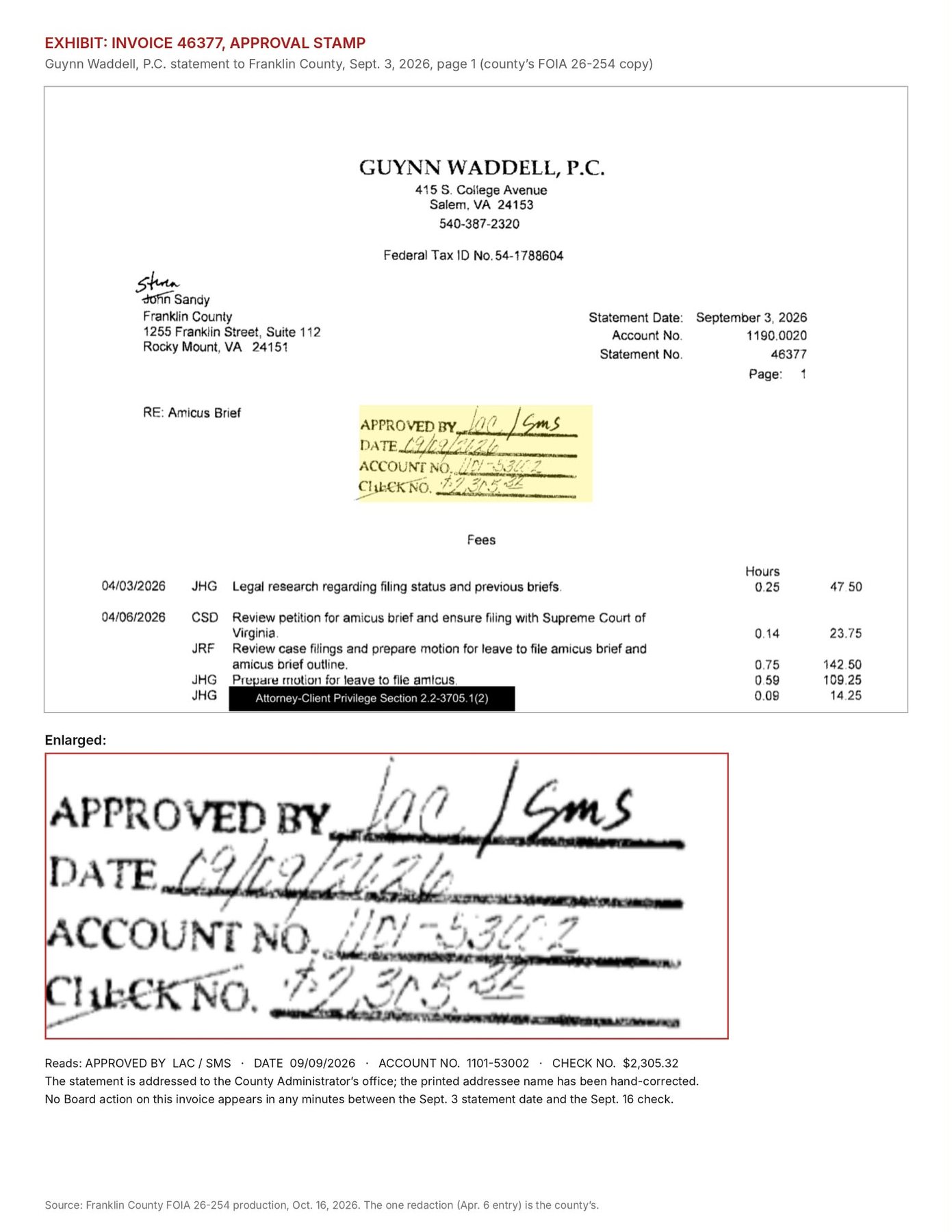
But the initials correspond to those of Senior Executive Assistant and FOIA Manager Lori A. Crouch and County Administrator Steven M. Sandy. The records reviewed for this series do not establish whether either official placed them on the invoice.
If the initials identify those individuals, what role did each play in reviewing or approving the payment? And what authority did that approval represent?
Former Supervisor Mike Meredith asked the question plainly.
“Why was a check approved to be cut for a bill that was never approved?”
The Virginia Constitution raises another question about the approval process.
Article VII, Section 7 requires a recorded affirmative vote of a majority of all elected members of a local governing body to pass an ordinance or resolution appropriating more than $500.
Franklin County paid $2,305.32 for its share of the amicus brief.
Was that expenditure covered by funds the Board had already appropriated? If so, who determined that the legal work fell within the authority granted by that appropriation?
Or did the work require additional Board action that the public record does not show?
The constitutional provision does not necessarily require a separate vote for every expenditure exceeding $500. But it makes the distinction between appropriating public money, authorizing legal work, and approving payment all the more important.
A routine payment approval is not necessarily the same as a Board decision to engage counsel. Nor does the payment alone prove anything improper.
Without the governing contract and approval records, the public cannot tell who made each decision. And so far, the Board has been less than forthcoming with any information.
The Attorney Asked the Board to Ratify His Firm’s Work
“I would appreciate it if maybe someone will make a motion to ratify our work in that regard,” Guynn said.
No motion followed.
Smith asked whether the matter was time-sensitive.
“Not necessarily,” Guynn said.
Smith then requested a written summary of the earlier resolution and proposed action.
That left the attorney explaining the authorization of work performed by his own firm.
The Board had requested an account from the same attorney whose firm had billed the county for the assignment under scrutiny.
That arrangement does not, by itself, establish a legal conflict of interest. But it raises a question of independent oversight: Who examines the attorney’s explanation and the underlying approval records when his own firm performed the work?
Supervisor Dan Quinn sought an independent legal review of the amicus matter and Guynn’s public remarks about closed-session subjects.
“The public would expect no less, and Mr. Guynn cannot credibly review himself,” Quinn wrote.
Quinn said Nov. 2 that he had received no official response. His account does not establish whether the Board had begun considering his request.
Talk More, Type Less
At the Board’s Jan. 5, 2026, organizational meeting, Guynn described the Freedom of Information Act as a means for citizens to see their government at work.
“You are conducting the business of the public for the folks of Franklin County,” he told supervisors. “You start from the premise that everything’s open and work back.”
Later, his advice took a different turn.
“Every one of you text and email too much,” he said. “And I don’t even know how many texts or emails you send. But if you’re sending any, you’re texting and emailing too much.”
He said those types of items are the things that people can access in FOIA.
What makes the remarks significant is not simply that Guynn encouraged supervisors to send fewer emails and text messages. He offered that advice during training intended to explain the public’s right to see how government conducts its business.
He recommended a method of communication that would leave fewer written records available to the public.
It was not the first time.
During the Jan. 2, 2025, organizational meeting, Guynn said he had omitted the point from his written materials because he “wouldn’t put it in writing.”
He advised that “the fewer emails and texts you send, the less FOIA is involved” and urged supervisors to “talk more and type less.”
Neither recording establishes that any supervisor avoided creating records about the amicus brief. There is no evidence in these materials identifying a particular telephone conversation through which the work was authorized.
But Guynn’s Jan. 5 training supplied another relevant standard—one that bears directly on his later request for ratification.
He explained that informal discussions of public business involving three supervisors may trigger open-meeting requirements. (That nuance is discussed in Who Answers to Whom? The Tatum Encounter.)
He also told supervisors that any agreement reached in a closed meeting was not effective until a public vote.
“You can vote, you can agree, you can jump up and down in a closed meeting, and everybody’s saying huzzah, we’re gonna do this,” Guynn said. “But it ain’t effective ‘till you vote on it.”
If the Board privately agreed to the amicus work, the records reviewed for this series still do not identify the open-session vote that made that agreement effective.
Those records do not establish that such a private agreement occurred.
The Standard the Board Set
At a Jan. 22 meeting, Smith told public school officials that taxpayer money demanded accountability and transparency.
“Our job is the high bar way up here of making sure that we have best practices, accountability, and transparency in place,” she said. “If it were on our side of the table, and our staff had made such egregious errors, you can rest assured I’d be saying the very same thing to our staff. It’s unacceptable.”
Her words provide a standard by which the Board’s own conduct can be measured.
The question is not whether $2,305.32 is a large expenditure or whether supervisors supported the underlying lawsuit.
It is whether residents can trace who ordered the work, who checked the authority for it, and who approved the bill. Currently, they cannot.
A resolution was approved.
A brief was filed.
A bill was paid.
A request for ratification followed.
And the public record still does not connect those steps with a documented open-session authorization.
The question remains: Who answers to whom?
Sources and supporting documents
- Franklin County Board of Supervisors, March 17, 2026: resolution and meeting records. Recording · Agenda and minutes
- Supreme Court of Virginia, McDougle v. Scott, Record No. 260127: amicus brief filed April 13, 2026; motion for leave to file dated April 6, 2026. Reproduced in Part One.
- Franklin County Board of Supervisors, Oct. 20, 2026: the request for ratification. Recording at 5:45:49 · Agenda and minutes
- Virginia Constitution, Article VII, Section 7: recorded votes on appropriations. Official text
- Virginia Freedom of Information Act: Virginia Code, Chapter 37 · § 2.2-3707, meetings of public bodies
- Franklin County Board of Supervisors, Jan. 5, 2026: organizational meeting and FOIA training. Recording · Board packet
- Franklin County Board of Supervisors and School Board, Jan. 22, 2026: joint meeting on school funding and accountability. Agenda and minutes
- Franklin County Board of Supervisors, Jan. 2, 2025: organizational meeting and FOIA discussion. Minutes
- Previous installments: The Tatum Encounter · Who Authorized the Amicus Brief, Part One · Part Two
- Additional reporting records: Invoice 46377, the Sept. 9 approval stamp, Sept. 16 payment documentation, and reporting correspondence and interviews. Obtained under Franklin County FOIA 26-254; no public URLs exist for these records.