Franklin County's Board of Supervisors has spent months questioning and criticizing the school system's financial management, demanding accountability for how taxpayer dollars are spent.
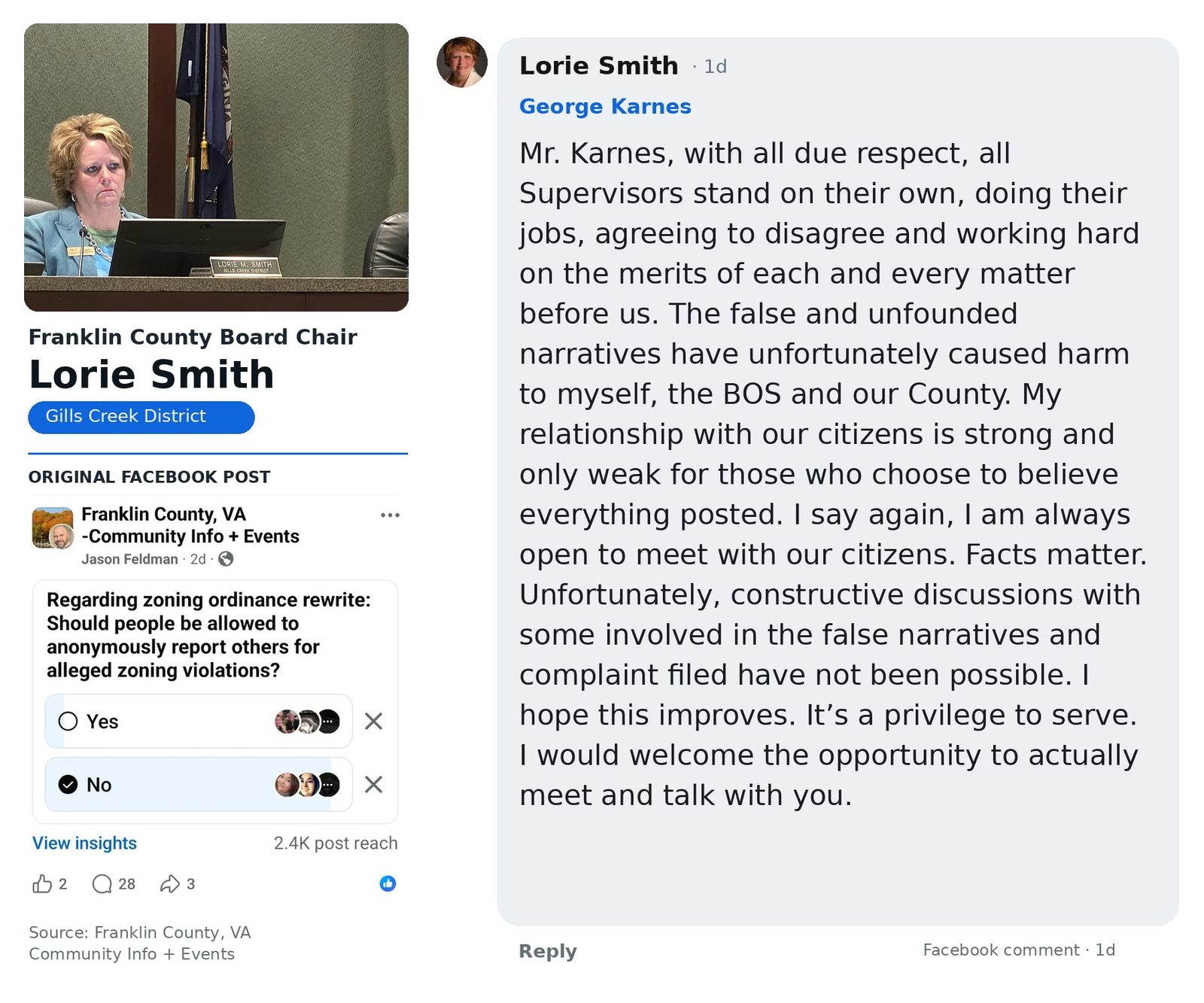
Board Chair Lorie Smith even publicly used the word "incompetence" to describe Superintendent Kevin Siers' administration over recent public school financial woes.
"At the end of the day, we are responsible for the very, very high bar of the allocation of taxpayer money," Smith told Siers at a Jan. 22 meeting. "Folks, it doesn't get any bigger than that."
And when the supervisors voted Oct. 20 against providing additional funding for school employee raises, it overshadowed a brief exchange between the county attorney and the Board that was left relatively unnoticed.
During that same meeting, County Attorney Jim Guynn acknowledged that his law firm had performed legal work associated with a Virginia Supreme Court case without an apparent authorizing vote in open session.
Transcript: County Attorney’s report, Oct. 20, 2026. Filler words removed; otherwise verbatim.
Chair Smith 5:45:49 Next up we have the county attorney’s report. Mr. Guynn.
Guynn 5:45:59 Just briefly, Madam Chair, back in April, the board authorized our firm to represent it in filing an amicus brief with regard to the redistricting. And in looking back at the records, it appeared that we never took action in an open meeting. And there’s been a FOIA request for whatever documents in that regard. And I thought just to clarify and make sure that everybody was on the same page that I would appreciate it if maybe someone will make a motion to ratify our work in that regard.
Chair Smith 5:46:37 Okay. Did you have questions?
Quinn 5:46:41 So Jim, I didn’t think that we had authorized work. I thought it was more of a symbolic support of that activity, not actually approving funding or authorizing work to do that. But I don’t know. I’ll hear the other board members, too. When I went back and looked, after some probing from constituents, I went back and looked at the item on the consent agenda just to see what it said.
Guynn 5:46:57 There were two things that went on, Dan. One was to show support for it with regard to a resolution, and the second, which was never on the agenda but was talked about in a closed session, was to authorize us to work with three other localities to file the amicus brief.
Chair Smith 5:47:25 Any other questions? I see some puzzled looks on some of my colleagues. Do you all recall this subject matter or would you like an update? Jim, is this time sensitive for this evening?
Guynn 5:47:38 Not necessarily.
Chair Smith 5:47:40 What I think would probably be helpful is to get a summary document, if you could prepare one, just to refresh everybody’s memory about the consent item and then the needed action of the board, maybe with some motion language to help us along.
Guynn 5:47:58 That’d be fine.
Chair Smith 5:48:01 Is that okay with everyone? Okay. All right. Thank you.
The county had already paid the firm $2,305.32.
Now Guynn wants supervisors to approve the work after the fact.
But Supervisor Dan Quinn says he never authorized the expenditure, never saw the court filing before it was submitted, and believed the Board had done nothing more than express symbolic opposition to a redistricting proposal.
"In looking back at the records, it appeared that ... we never took action ... in an open meeting," Guynn told supervisors.
He said a Freedom of Information Act request had prompted him to review the records and asked whether someone would make a motion to ratify the work.
No motion followed.
Instead, Smith requested additional information before supervisors considered taking action.
The exchange left a central question unanswered:
Who authorized Franklin County's participation in the partisan lawsuit?
A Resolution and a Court Filing
The dispute traces to a March 17 Board meeting, when supervisors approved a resolution opposing a proposed redistricting referendum.
The resolution was included on the consent agenda, a collection of items generally approved together without separate debate unless a member requests otherwise.
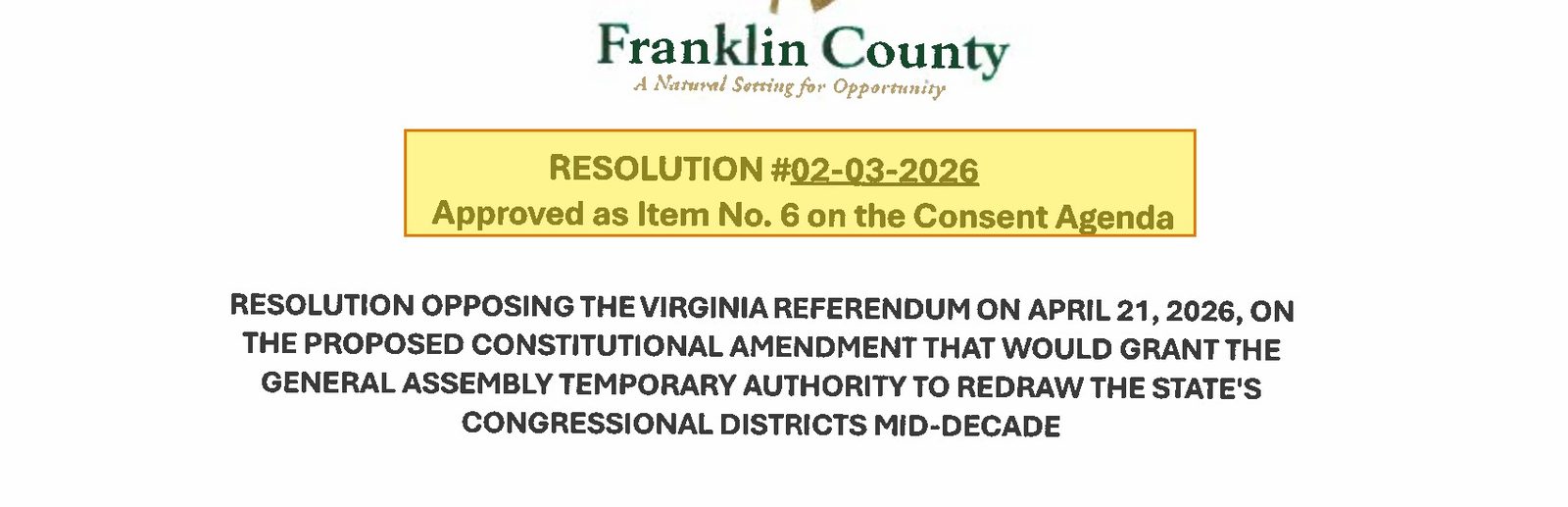
Quinn said he understood the resolution as an expression of the Board's position, not authorization to hire attorneys, incur expenses, or participate in litigation.
He compared the resolution to earlier statements on gun rights and other statewide issues.
"Such resolutions," he explained, "let localities communicate their positions to legislators without committing money to a court case."
The redistricting resolution, Quinn said, was similarly symbolic.
That distinction became significant when an amicus curiae brief was filed April 13 in a Virginia Supreme Court case concerning redistricting.
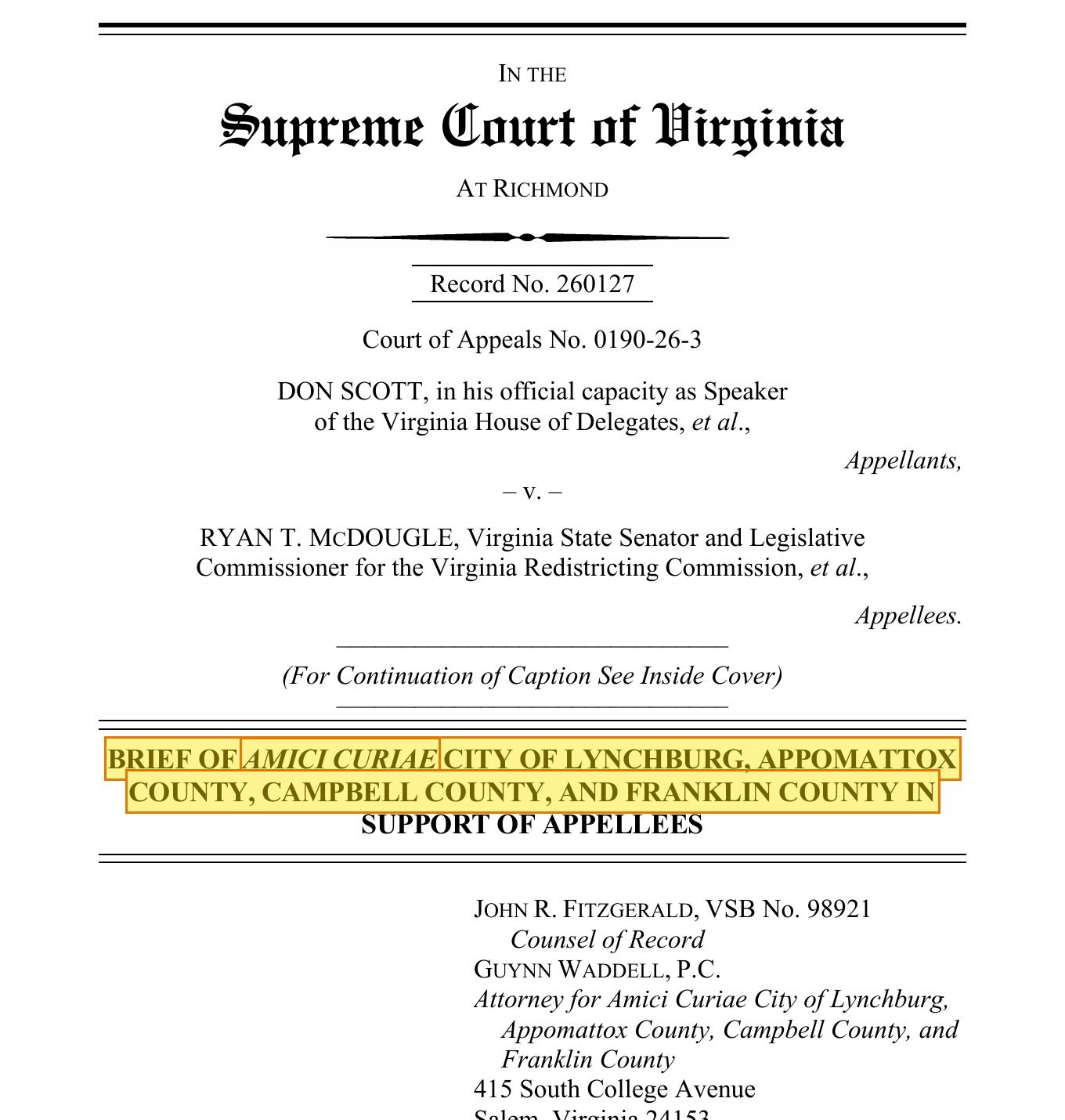
An amicus brief allows an individual or organization that is not a direct party to litigation to offer arguments or information for the court's consideration.
Franklin County was identified among the localities participating in the filing, along with Appomattox County, Campbell County, and the city of Lynchburg.
Botetourt County offers a contrast.
Its Board of Supervisors voted publicly Feb. 24 to support participation in the proposed amicus effort. In an Oct. 29 email to a citizen advocate, Celeste Parker, executive assistant to Botetourt County Administration, wrote that the city of Lynchburg had retained an attorney to prepare the brief for participating localities.
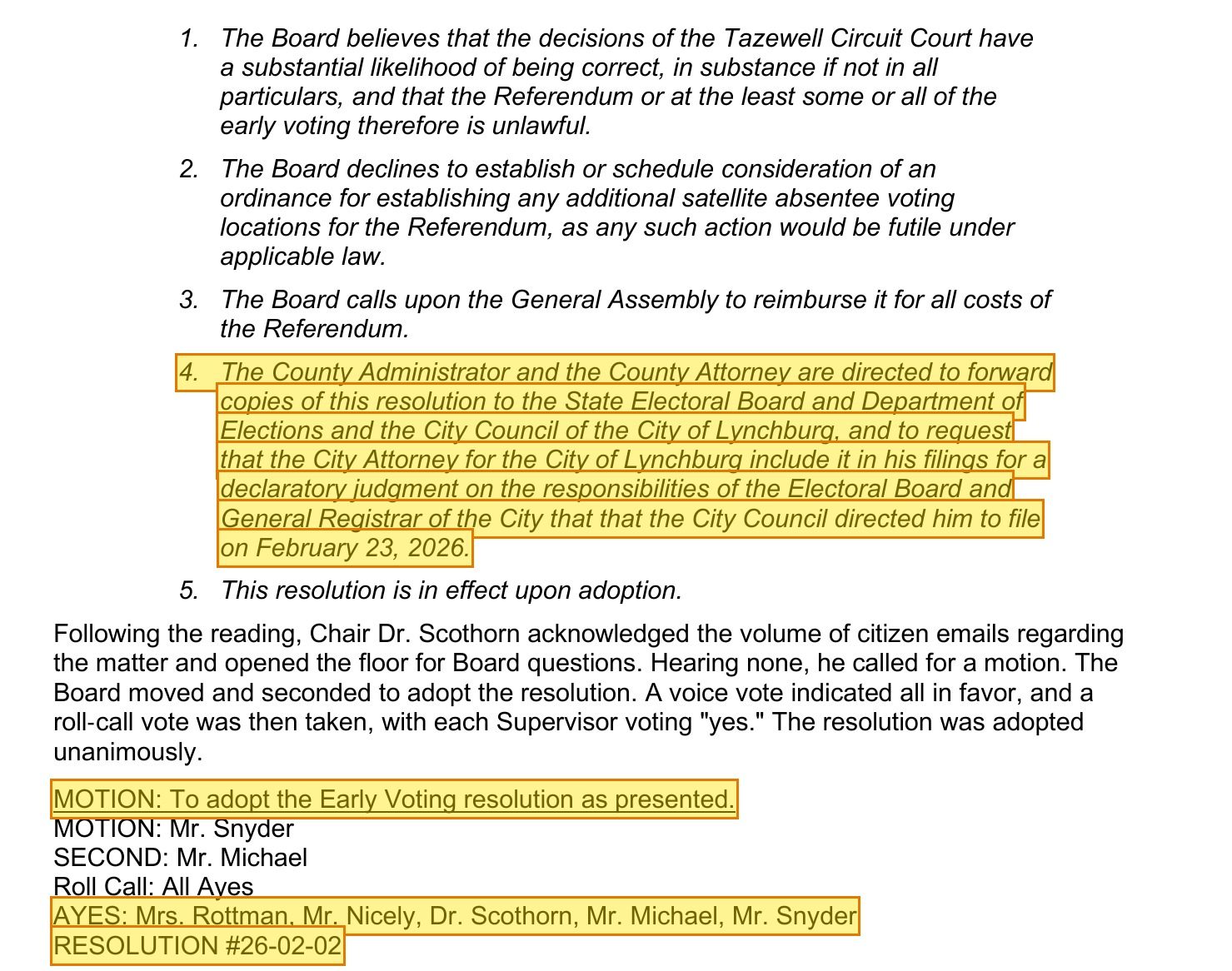
Parker said Botetourt received a draft only about five hours before the filing deadline.
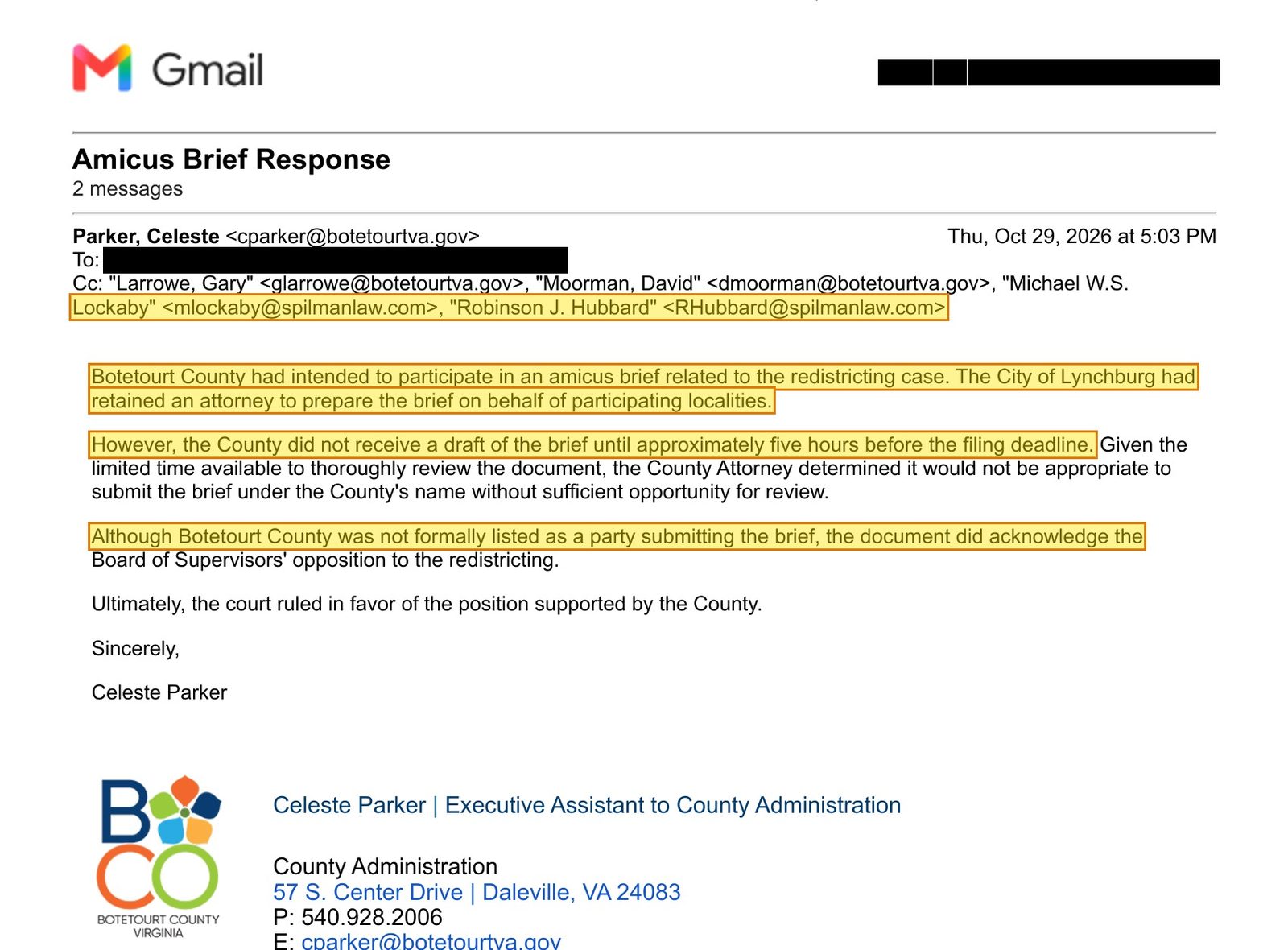
Its county attorney determined that was insufficient time to review a document to be submitted under the county's name, so Botetourt was not included among the four localities named in the final brief.
Parker said the brief nevertheless acknowledged Botetourt's opposition to redistricting.
An April 6 motion for permission to file had named Botetourt among five proposed participating localities. The final brief, filed April 13, named four: Lynchburg, Appomattox County, Campbell County, and Franklin County.
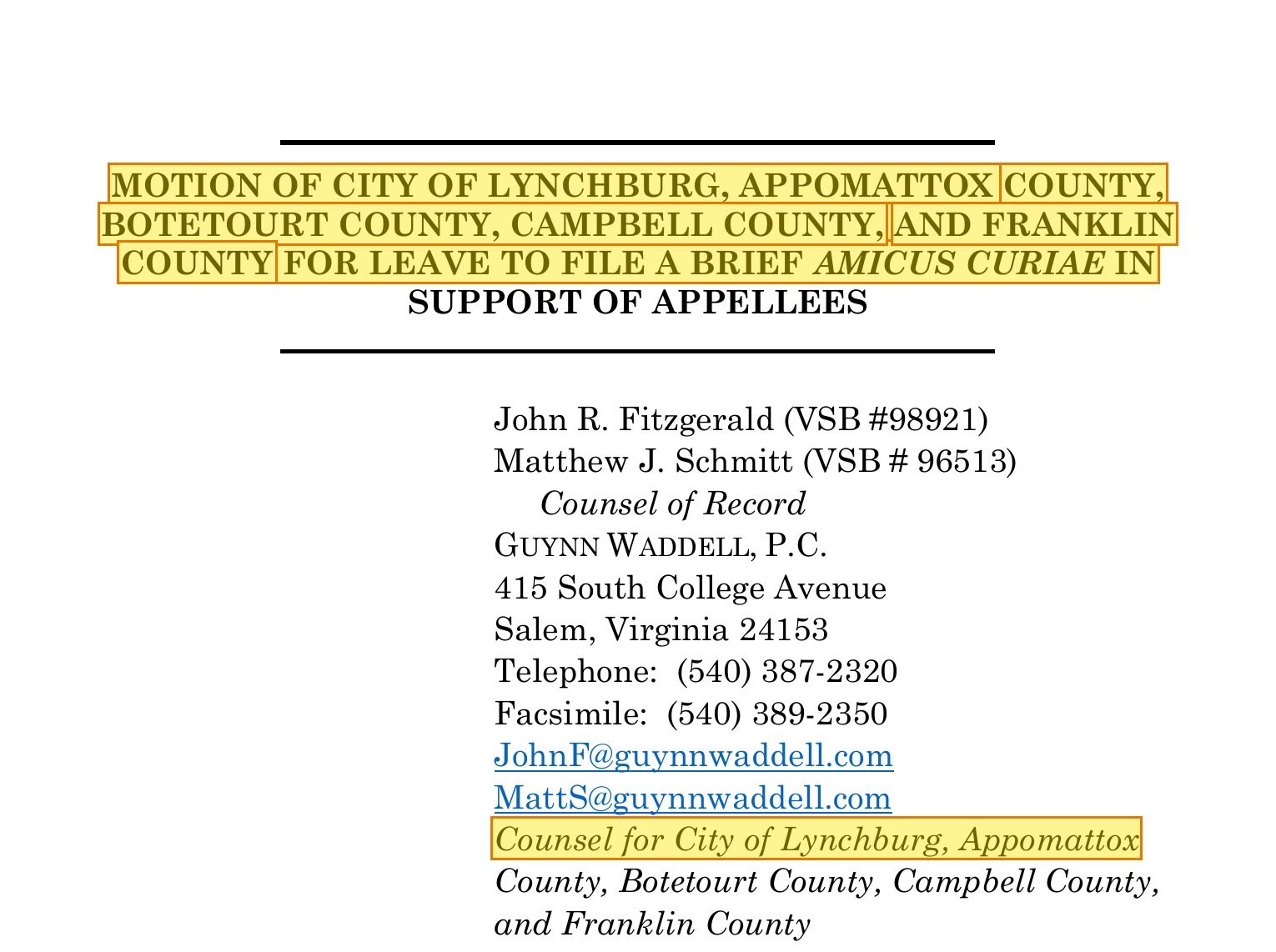
The contrast raises a question for Franklin County.
Who reviewed the final brief on the county's behalf before its name appeared on the filing, and who authorized that participation?
County payment records obtained through a public records request show that the county paid for legal work associated with the brief in September.
The March 17 resolution called upon the Virginia Supreme Court and General Assembly to uphold constitutional procedures and directed the clerk to send copies to legislators.
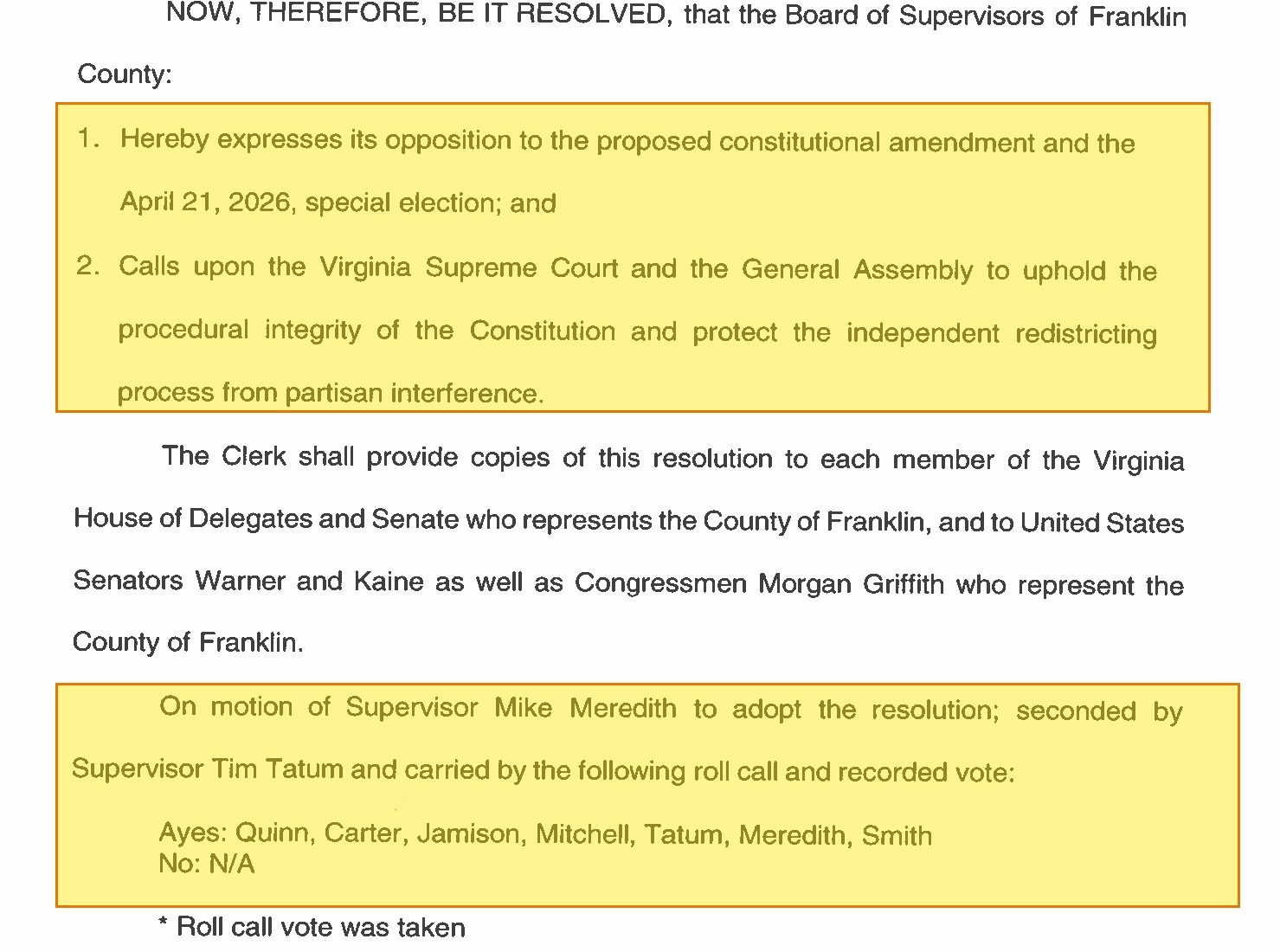
The signed resolution does not expressly authorize filing a court brief, retaining counsel for the filing, or committing money to it.
Whether other existing authority permitted the filing remains an unanswered question.
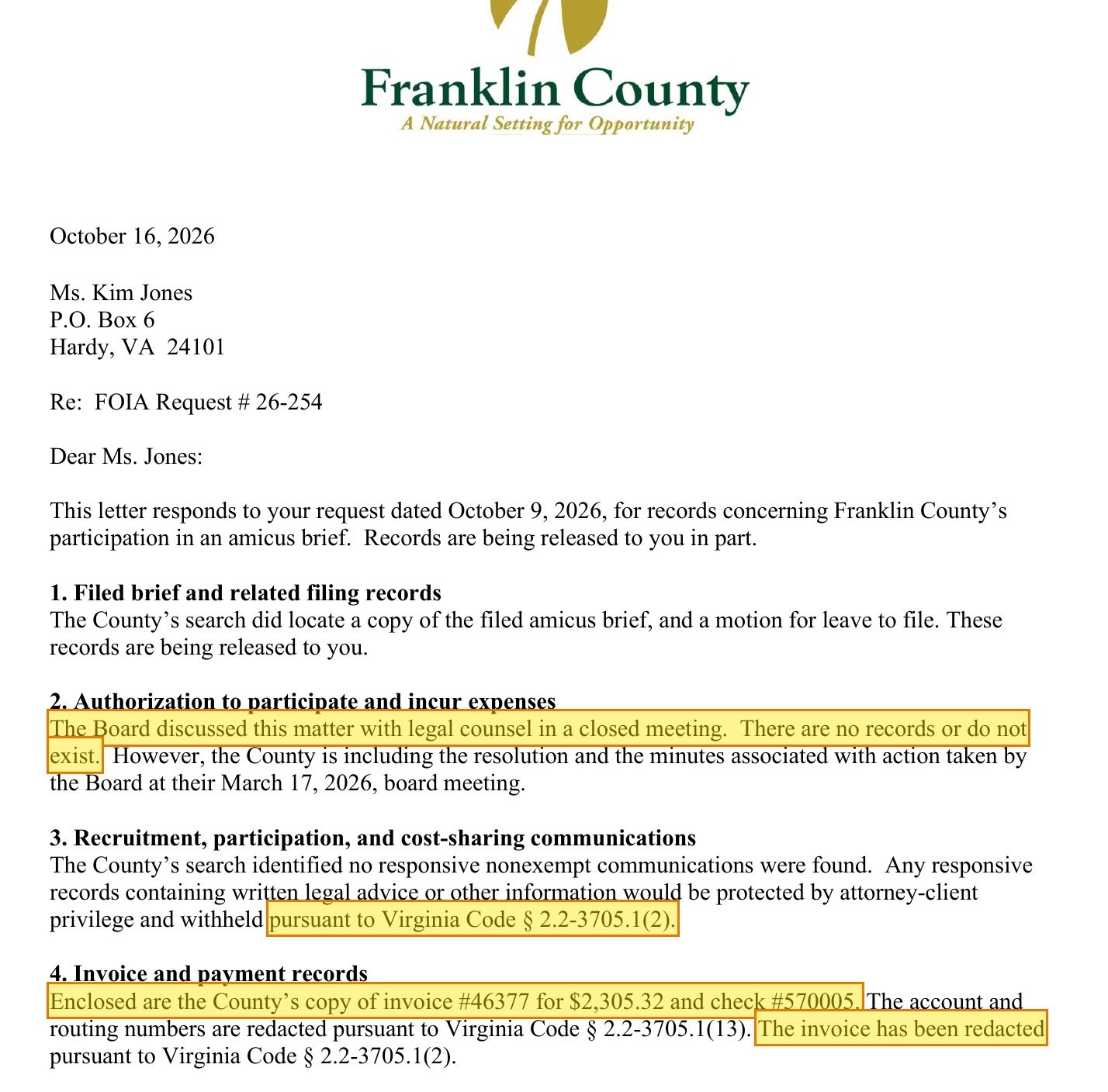
Quinn said the legal expenditure came to his attention only after questions arose about the county's payments.
Additionally, former Supervisor Mike Meredith described a similar understanding of the March resolution.
"As far as I know, that should have been it," he said, adding that the consent item contained nothing about fees or funding.
Quinn said he was neither shown the brief nor asked to approve Franklin County's participation before it was filed April 13.
Reviewing the consent agenda afterward did not change his understanding. Meredith likewise questioned who approved the expense.
"I would think that that should have come before a board vote," he said, "since it is representing the board and the county."
Neither Quinn nor Meredith said he had authorized the legal work.
Supervisor Tim Tatum also questioned the procedure surrounding the expenditure.
"It definitely should have been voted on in open session before it was paid," Tatum said in a text-message exchange.
Tatum could not identify who had authorized Guynn to prepare the brief and incur the expense.
"If we didn't vote on it, I don't know," he said.
What Happened Behind Closed Doors?
During the Oct. 20 meeting, Guynn offered an explanation.
"There were two things that went on, Dan," he told Quinn.
One was the public resolution expressing opposition to redistricting.
"[The other] was never on the agenda but was talked about in a closed session," Guynn said.
That second discussion, according to Guynn, concerned authorizing his firm to work with three other localities to file the amicus brief.
His statement introduced another set of questions.
When did that closed meeting occur? What exemption permitted the discussion? And did supervisors actually authorize the work?
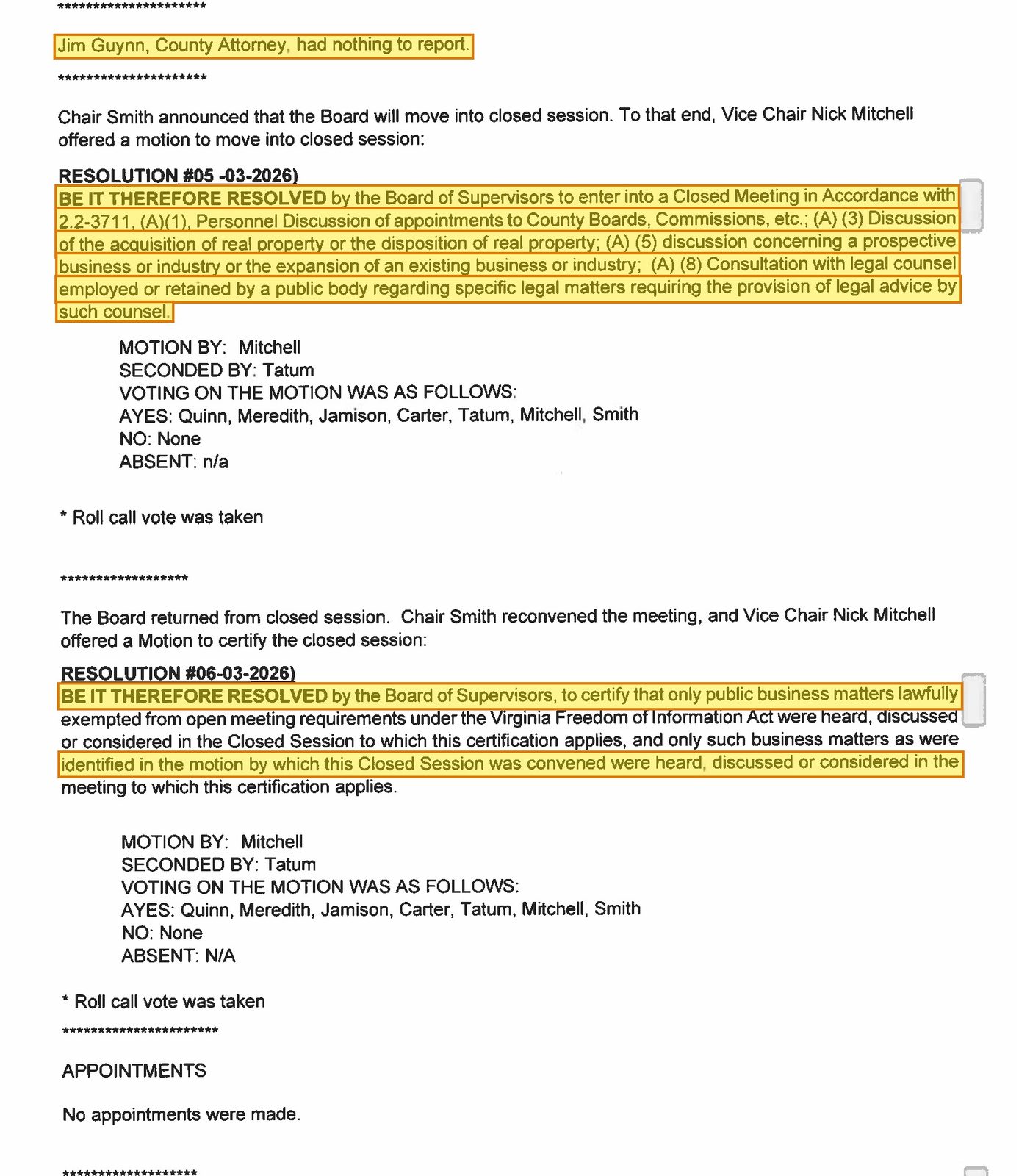
Virginia's Freedom of Information Act permits public bodies to meet privately for certain specified purposes, including some consultations with legal counsel. However, the law also imposes requirements on how closed meetings are authorized and how official action is taken.
A decision reached in a closed meeting does not become effective without a subsequent vote in open session.
Guynn's acknowledgment that no open-meeting action apparently occurred raises questions about whether the county's participation and expense was properly authorized.
Quinn said he initially did not recall the closed-session discussion but subsequently confirmed that the subject had been discussed after Guynn publicly identified it.
Quinn nevertheless maintained that he never understood any private discussion as authorization to proceed.
"I did not believe that authorized us to go forward with it," Quinn said.
He explained that he believed a public vote was necessary before the county could undertake substantive action or spend money.
Meredith offered a partial recollection of the private discussion.
He remembered talk that counties might save money by working together if they decided to challenge the state's redistricting process, but he did not recall a dollar amount or a vote authorizing the expenditure.
"That was very vague," Meredith said. "That's about the only thing I really remember."
Meredith also said a county attorney's role includes advising supervisors on proper procedures so that decisions and expenditures are handled correctly. His concern was that work had been performed and paid for without the public vote he expected.
Quinn questioned whether the amicus discussion belonged in a closed meeting in the first place.
"I don't think it was proper for it to be discussed in a closed session," he said.
He also maintained that spending money and taking an official position required a public vote.
In an Oct. 21 Facebook post, Quinn asked why the amicus matter was not identified on the closed-session agenda, and why it was discussed privately if it did not qualify for an exemption.
Virginia law provides several exemptions for closed meetings, including certain legal consultations. Whether this particular discussion qualified depends on the circumstances and the motion authorizing the session.
The date of the discussion remains important.
The brief was filed April 13. A closed meeting held afterward could not, by itself, establish that the Board had authorized the filing beforehand.
The available records and interviews do not yet establish precisely when the discussion Guynn referenced occurred.
Whose Interests Were Served?
The amicus filing raises questions beyond the mechanics of Board authorization.
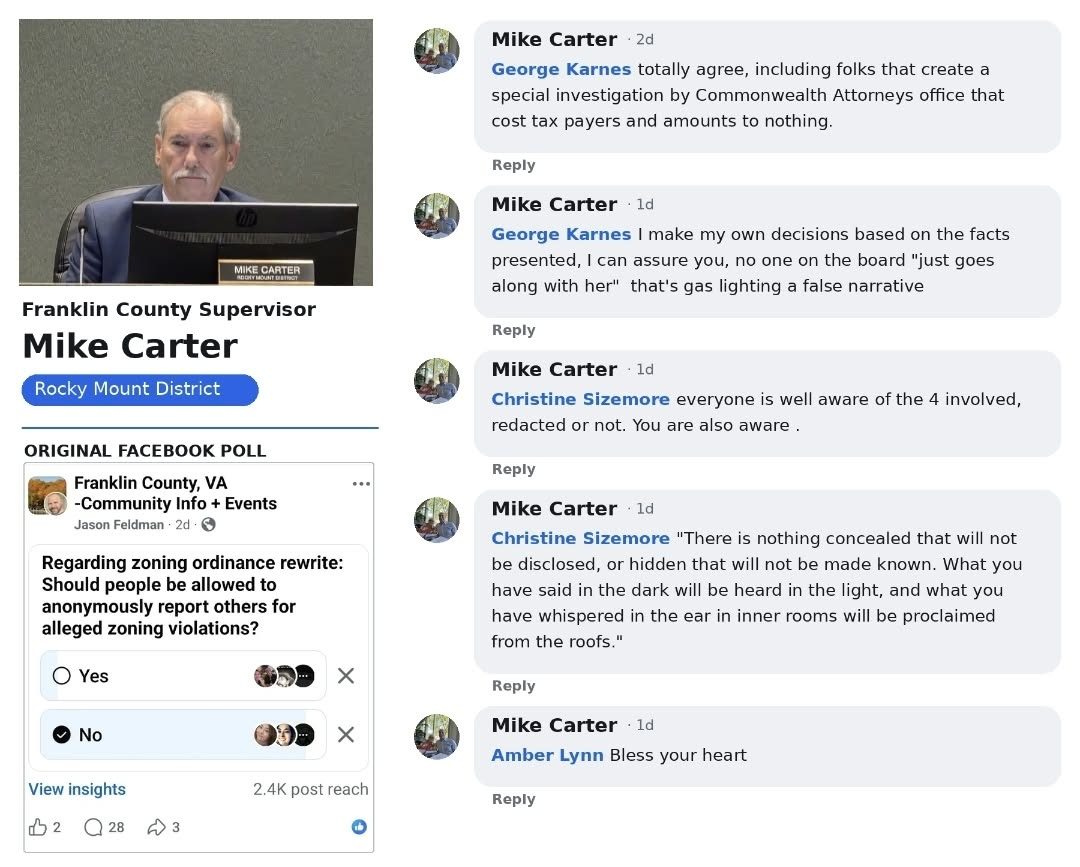
County records newly obtained through a Freedom of Information Act request identify Supervisor Mike Carter as the official who requested that the redistricting resolution be placed on the Board's March 17 consent agenda.
In a Feb. 27 email to Board Chair Smith, Vice Chair Nick Mitchell and County Administrator Steve Sandy, Carter said constituents had contacted him with concerns about proposed congressional redistricting.
"I am formally requesting a resolution be placed on the upcoming county agenda," Carter wrote.
Carter requested that a resolution opposing the proposed redistricting plans be placed on the agenda, citing concerns that the plans could dilute rural and conservative representation.
Quinn previously questioned the consent agenda's attribution of the resolution request to county staff.
"I don't know who's represented when they say county staff," he said. "It seems very odd to me that the county staff would take a fairly controversial position like that."
The email establishes who requested the resolution. It does not establish who subsequently proposed Franklin County's participation in the Virginia Supreme Court filing or who authorized the resulting legal expense.
The distinction matters because expressing opposition to a redistricting proposal and committing public resources to a Supreme Court filing are separate actions.
Carter was contacted by email Oct. 28 and asked why he requested the resolution, whether he also requested or supported the subsequent amicus filing, and whether he knew of or participated in authorizing the legal expenditure.
An automatic reply from Carter's county email account acknowledged receipt of the message, stating, "Your email message is very important. I am acknowledging receipt."
But as of publication, Carter had not provided a substantive response to those questions.
And that raises several more questions.
What did Franklin County stand to gain from participating in the case?
Did county officials identify a specific legal, financial, or governmental interest that the filing would protect? Or was participation primarily an expression of opposition to redistricting?
The available records do not establish what assessment, if any, preceded the decision to join the brief.
The expenditure also raises a question about the use of public money in politically contentious litigation.
Quinn called the expenditure inappropriate because he considers the redistricting dispute partisan.
"The county shouldn't be spending money on it," he said. "They shouldn't be picking a side."
The political nature of a dispute does not, by itself, establish that a locality is prohibited from participating.
What remains unclear is the specific governmental interest Franklin County sought to protect and who determined that the expense was justified.
The firm's itemized bill also identifies work beginning April 3, including research attributed to Guynn, followed by preparation of a motion for leave to file on April 6. One April 6 billing description was redacted from the county's released copy and marked as privileged.
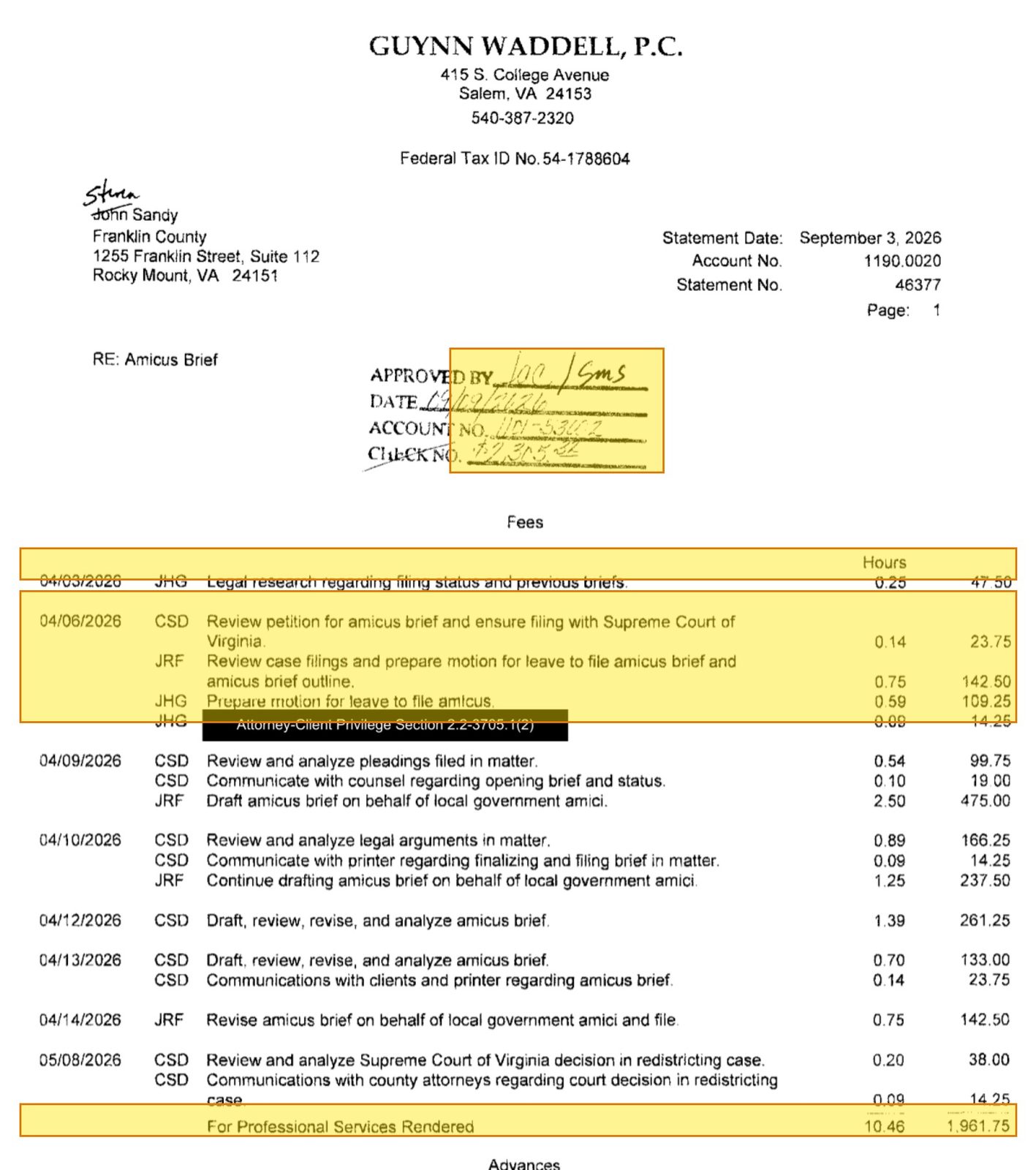
The redaction does not establish what was discussed or who authorized the work, but it leaves a potentially important gap in the public accounting.
The payment records do, however, identify a direct financial recipient of the county's participation:
Guynn Waddell P.C., the law firm representing Franklin County.
The firm received $2,305.32 for work associated with the filing, according to county payment information.
Invoice 46377, dated Sept. 3, itemizes $7,847 in legal fees and $1,374.19 in copying advances, totaling $9,221.19.
The firm allocated the charges equally among Franklin, Campbell and Appomattox counties and the city of Lynchburg.
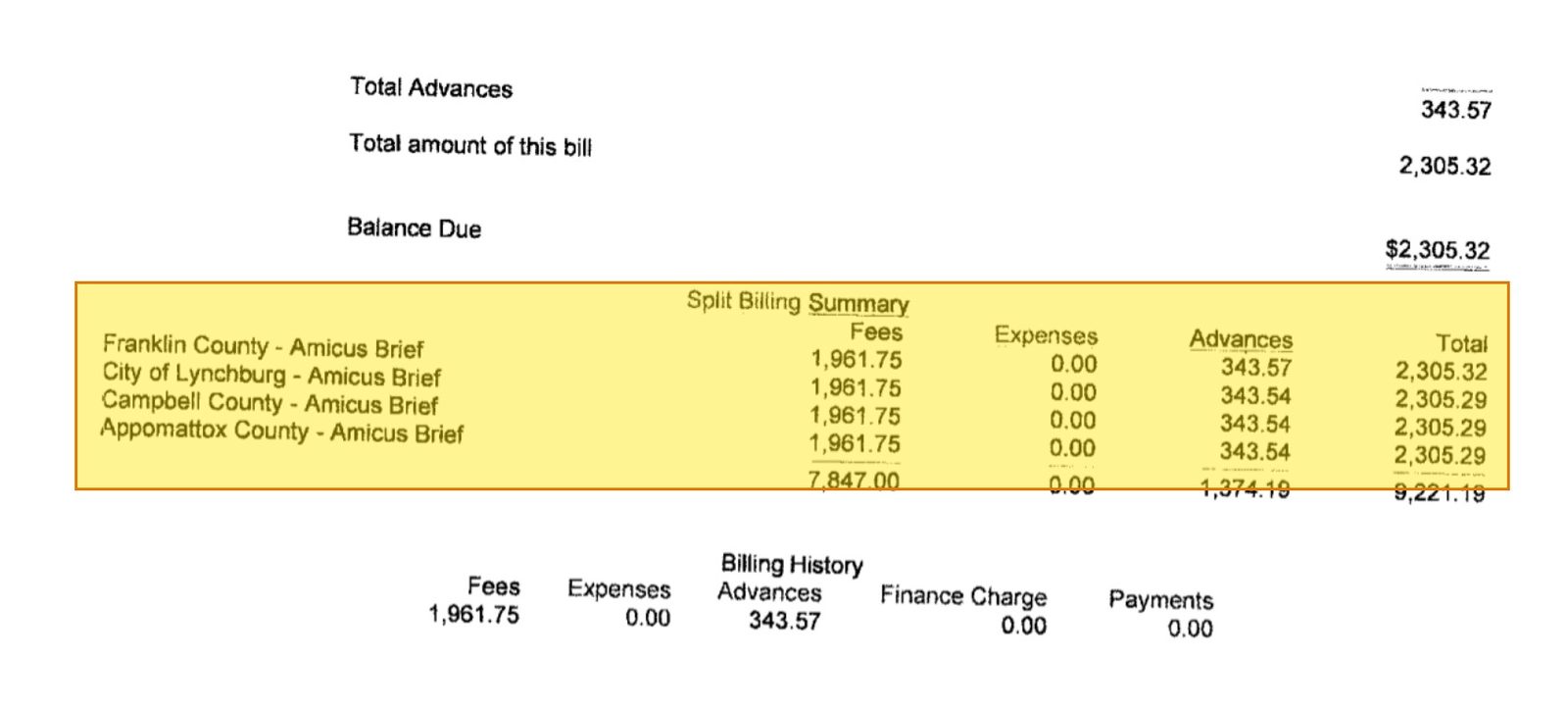
Franklin's $2,305.32 share included $1,961.75 in legal fees and $343.57 in copying costs. The county's settled check is dated Sept. 16.
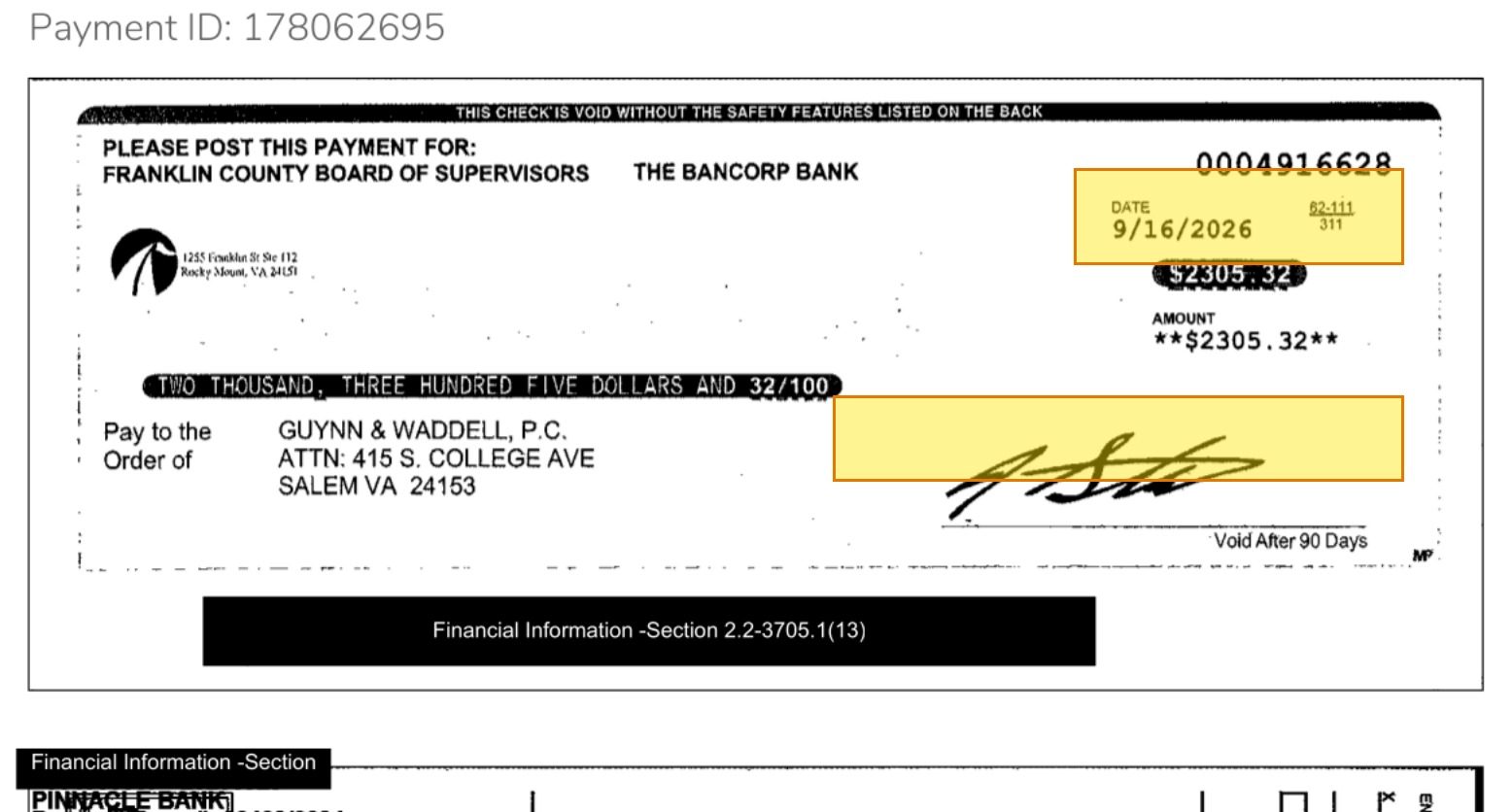
Payment for authorized legal services is not inherently improper. Nor does a law firm's participation in a significant case establish a conflict of interest.
But participation in a Virginia Supreme Court case can offer benefits beyond immediate compensation, including professional visibility, experience, and the opportunity to establish or enhance a firm's reputation.
Did those potential benefits play any role in the decision to participate?
Did Guynn Waddell recommend that Franklin County join the filing, or did county officials independently request the firm's services?
And what safeguards governed the decision to undertake legal work from which the county attorney's firm would receive compensation?
Those questions remain unanswered.
The Questions Continue
The questions surrounding the filing extend from the March resolution to the September payment:
Who requested the legal work, what authority supported it, and who approved the expense?
Guynn told supervisors that a closed-session discussion had authorized the work, but he also acknowledged that an open-session vote apparently never occurred.
But Guynn's explanation introduced another question.
In telling supervisors how the legal work had been authorized, the county attorney publicly described a discussion he said had occurred behind closed doors.
That disclosure raised a separate question about accountability—one that had already carried consequences for other members of the Board:
Who decides what can be revealed about a closed meeting, and who is held accountable when those boundaries are crossed?
Part II will examine that.
Check the record
- Oct. 20, 2026 regular meeting (county attorney’s report, 5:45:49). Watch the recording · Agenda and minutes
- March 17, 2026 regular meeting (consent agenda, Resolution 02-03-2026; closed session). Watch the recording · Agenda and minutes
- Jan. 22, 2026 joint meeting of the Board of Supervisors and School Board. Agenda and minutes
- Supreme Court of Virginia, Record No. 260127. Amicus brief filed April 13, 2026; motion for leave to file dated April 6, 2026 (Figures 2 and 5).
- Franklin County FOIA 26-254. Response dated Oct. 16, 2026 (Figure 7); invoice 46377 and settled check (Figures 9 to 11).
- Botetourt County Board of Supervisors, Feb. 24, 2026. Resolution 26-02-02 (Figure 3).