Franklin County Attorney Jim Guynn stands in the county boardroom in front of a TV camera. He explains to a WDBJ7 reporter what comes next in the county’s search for a new administrator.
It’s Oct. 5, and the Board of Supervisors has just met behind closed doors to discuss the search.
Guynn describes the qualifications supervisors are seeking, how the selection process will proceed, and the likelihood that someone will have to fill the position temporarily.
“The expectation is that they’ll have to appoint an interim,” Guynn says during the interview.
He also discusses what the Board did not consider during its private meeting.
Recent controversies surrounding county government, he tells the reporter, were not among the subjects discussed.
“That wasn’t part of the conversation today,” Guynn says.
Fast forward to Oct. 20.
Guynn is speaking publicly again. This time, he is addressing the Board of Supervisors during its monthly meeting.
The subject has changed.
Guynn is seeking retroactive approval for legal work on a Virginia Supreme Court amicus brief.
His firm has already received $2,305.32 from Franklin County, and the public record does not establish an authorizing vote in open session.
As he explains the work, Guynn describes another matter he says was discussed behind closed doors.
“And the second, which was never on the agenda but was talked about in a closed session, was to authorize us to work with three other localities to file the amicus brief,” he tells supervisors.
Two public appearances, 15 days apart.
Two different matters Guynn says were discussed behind closed doors.
And two occasions when the county attorney described those discussions publicly.
Neither disclosure went unnoticed.
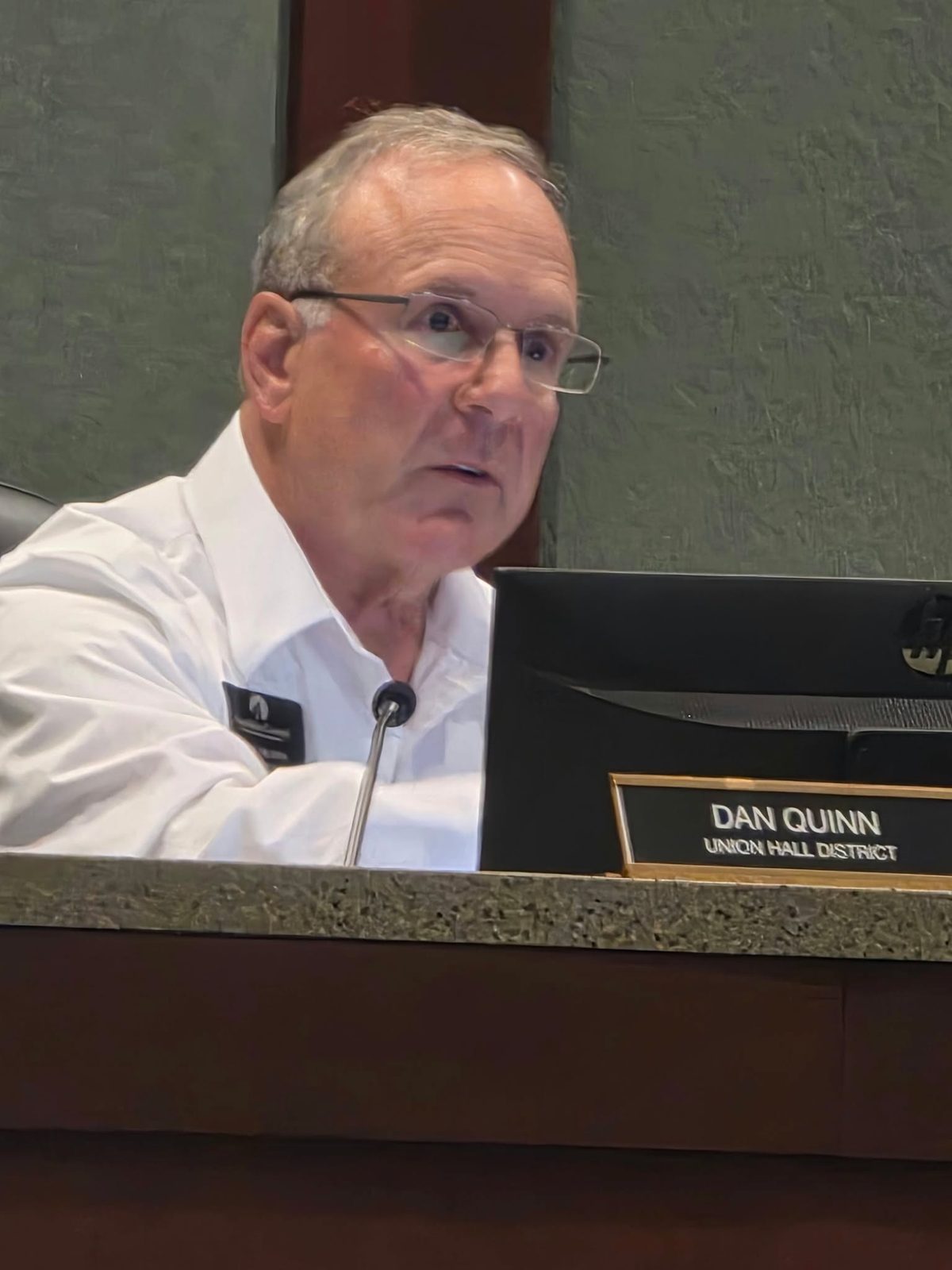
“Again, he spoke about a closed session to the public, which is shocking to me,” Supervisor Dan Quinn said.
A Call for Independent Review
Six days after the Oct. 20 meeting, Quinn put his concerns in writing.
In an Oct. 26 email to Board Chair Lorie Smith, obtained through the Virginia Freedom of Information Act, Quinn sought a written accounting of both Guynn’s television interview and the amicus brief controversy.
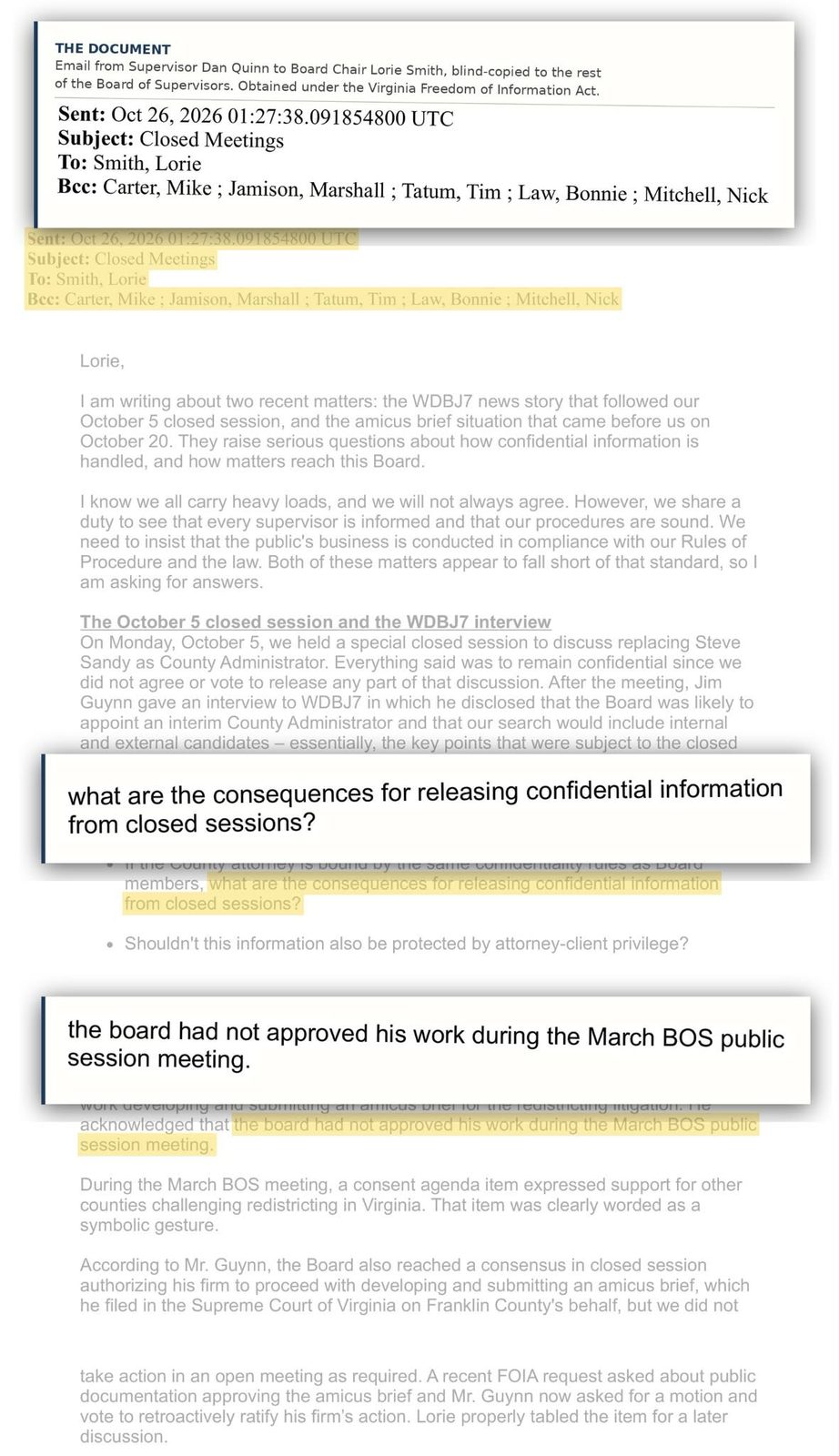
The email also lists Supervisors Mike Carter, Marshall Jamison and Tim Tatum, Boone District Supervisor Bonnie Law—who was appointed by the Board to succeed former Supervisor Mike Meredith—and Vice Chair Nick Mitchell as blind-copy recipients.
His request went beyond questioning whether the county attorney had permission to discuss closed-session matters. Quinn called for an examination of Guynn’s role by independent legal counsel.
“Secondly, because Mr. Guynn’s own conduct is at issue in both matters, I am asking for a review of his role by independent legal counsel,” Quinn wrote. “The public would expect no less, and Mr. Guynn cannot credibly review himself.”
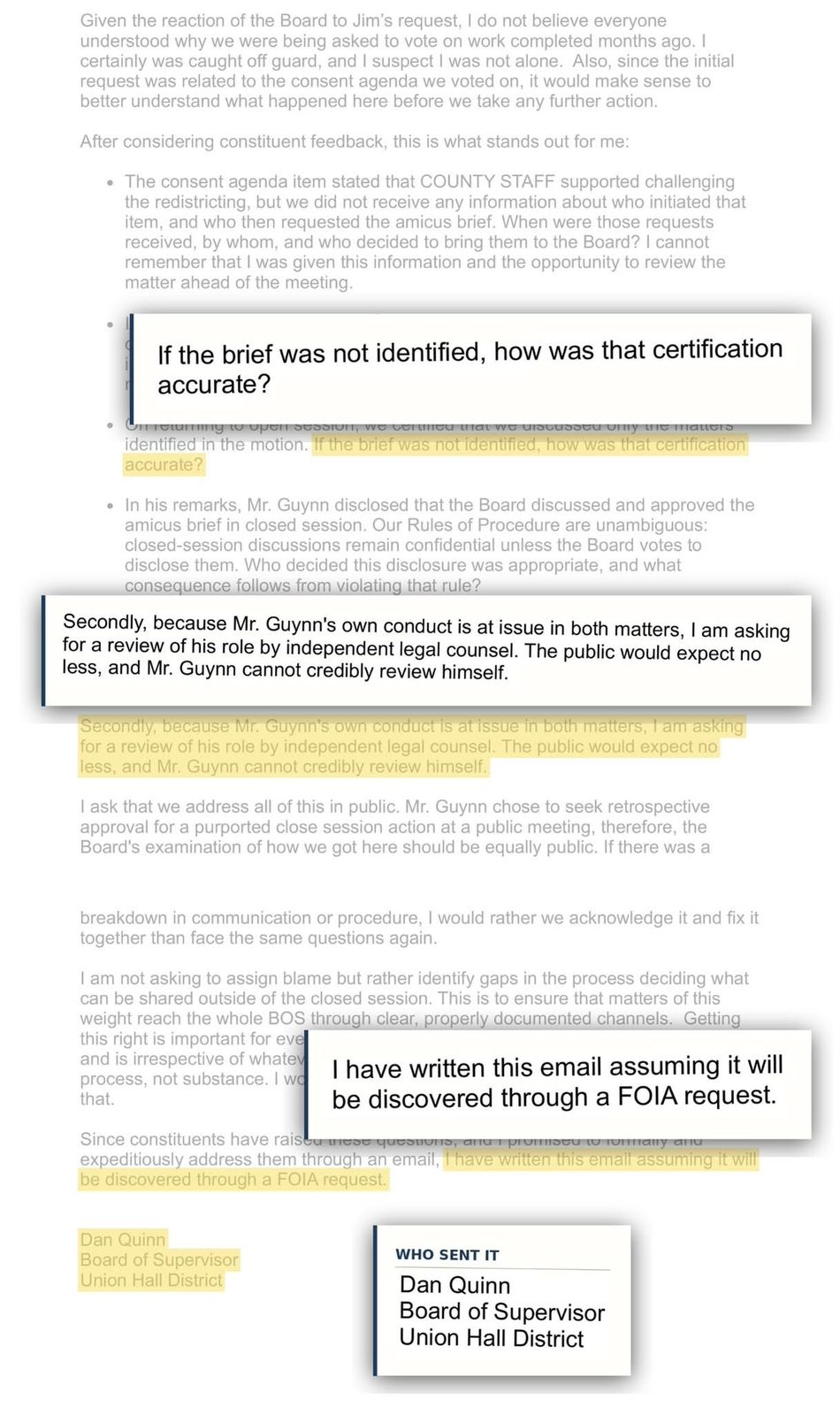
Quinn also sought written answers to his questions and urged supervisors to address the issues publicly.
“I ask that we address all of this in public,” he wrote.
His questions extended beyond confidentiality.
Quinn sought to know who initiated the March resolution supporting the redistricting challenge, who requested the subsequent amicus filing, and how the matter reached the Board.
He also questioned whether the closed-session motion and subsequent certification properly accounted for any discussion of the brief.
Quinn emphasized that he wanted to identify gaps in the process rather than assign blame.
“This is about process, not substance,” he wrote.
The email establishes that Quinn requested independent review; it does not establish that the Board has authorized one or how Smith and other supervisors have responded.
In a Nov. 2 interview, Quinn said he had received no official response to his Oct. 26 request for independent legal review. That account does not establish whether Smith or other supervisors have discussed the request or begun considering it.
Those questions now join the dispute over what was said behind closed doors—and what was disclosed afterward.
Another Disclosure Question
In explaining the work, Guynn identified the subject of a discussion he said had occurred in a closed meeting. His public account did not establish when the discussion occurred or who, if anyone, authorized him to describe it.
The Board’s published March 17 agenda listed four grounds for entering closed session.
A transcription of the motion from the meeting recording likewise cites Virginia Code § 2.2-3711(A)(1), (3), (5) and (8), covering personnel matters, real estate, prospective business or industry, and consultation with legal counsel on specific legal matters requiring legal advice.
Neither the amicus brief nor the redistricting litigation is specifically identified in the transcribed motion. The motion’s general reference to legal consultation does not establish whether the amicus filing was discussed behind closed doors.
The recording also identifies a closed-session certification segment, but the screenshots provided do not establish the wording of the certification or the vote. Nor does certification alone establish what subjects were discussed.
At the Oct. 20 meeting, Guynn said the Board had authorized his firm’s participation “back in April.”
Yet the available Board records identify no meeting between April 1 and the April 13 filing.
Guynn did not specify the date of the closed session he referenced. The March 17 meeting is one possible occasion for that discussion, but the available records do not establish that it occurred then.
Quinn objected to Guynn’s public account of the closed-session discussion.
Quinn had previously been censured following a dispute over disclosure of closed-session information. Former Supervisor Mike Meredith also faced criticism over information allegedly originating in private Board discussions.
Neither controversy, by itself, establishes that Guynn’s remarks violated the same rules.
Still, the comparison raises questions about how those rules are applied, who enforces them, and who exercises that discretion.
Quinn said he was not involved in permitting Guynn to discuss the amicus matter publicly.
“I was not part of authorizing him to do that,” he said.
Quinn acknowledged that Smith or another official might have given permission without his knowledge.
“We have to all agree on what can be released,” Quinn said, describing his understanding of the Board’s confidentiality practices.
Supervisor Tatum also said he had not participated in authorizing Guynn to discuss the closed-session matter publicly.
“If he was authorized, it would have come from Lorie [Smith]. I was not [part of the authorization]. But that doesn’t mean it didn’t happen. Several of us were talking,” he said, leaving open the possibility that authorization occurred without his participation.
Quinn also raised concerns about the earlier television interview in which Guynn discussed the county’s search for a new administrator, including the possibility of considering outside candidates and appointing an interim administrator.
Quinn said the Board had discussed the administrator search privately and challenged whether the attorney had authority to discuss it publicly.
“We didn’t agree on what could be released,” he said of the television interview. “When I comment about how Jim shared information, it’s more the principle of the thing, as opposed to the content.”
The question is whether Guynn was describing already-public information or revealing details that remained confidential. Quinn maintains the Board had not agreed to release the information. The available record does not establish a legal or policy violation.
Meredith likewise questioned the differing treatment of disclosures.
He contrasted the public comments about the amicus discussion and the administrator search with the criticism he faced after saying the proposed data center known as Project Flash was not progressing.
He also pointed to Smith’s public statement that the Board was not currently talking with data centers.
“I’m kind of curious, what’s the difference?” Meredith asked.
Virginia law does not automatically prohibit every public reference to a closed-session subject. Whether the remarks disclosed protected information or violated a Board rule has not been established.
The Board’s Rules of Procedure adopted Feb. 17 also address closed-meeting confidentiality.
Section E prohibits Board members from disclosing closed-meeting information or discussions without Board approval. It further directs the Board, when confidential or privileged information is disclosed without consent, to vote either to authorize the disclosure or reaffirm confidentiality or privilege.
Those provisions expressly govern Board members; they do not, by themselves, establish that the same requirements apply to the county attorney or that Guynn violated them.
The question remains, however, as to whether the Board applies a consistent standard when its members—or its attorney—speak publicly about private discussions.
Section H of the adopted rules allows the chair and vice chair to consult the county attorney when considering alleged violations by Board members.
It does not specify how an independent review should be handled when the county attorney’s own conduct is questioned, as Quinn has requested.
An Unexpected Request—and Another Potential Expense
Guynn’s disclosure arose during his request that supervisors ratify legal work for which his firm had already been paid. The Board did not act on that request Oct. 20.
Quinn said the request caught him by surprise.
“I was totally blindsided that that was going to come up as a topic,” he said.
Quinn challenged the assertion that the Board had authorized the legal work.
His objection, and the resolution underlying it, were examined in the first installment.
Whose Motion Makes the Agenda?
The Oct. 20 request also invites comparison with procedural guidance Guynn gave supervisors at two earlier meetings.
On Jan. 20, Quinn moved for a five-year moratorium on accepting, processing, and approving applications for new utility-scale solar energy facilities.
Smith asked whether Quinn had formally submitted the motion and sought a second.
“It is not on the agenda, Madam Chair, therefore, will be out of order,” Guynn said.
Smith then asked Quinn to withdraw the motion and suggested placing the matter on a future agenda.
Then, at the July 21 meeting, then-Supervisor Mike Meredith sought to revisit a motion from the previous meeting. Smith consulted Guynn about the matter because it had not been advertised.
Meredith raised the rules changes during “Other Matters from Supervisors,” the agenda portion in which Section 8 permits individual supervisors to bring topics before the Board.
But Guynn said the motion wasn’t possible.
“It’s not just my opinion; the statute changed July 1 that said you can’t add anything to the agenda,” Guynn said, according to the meeting transcript and official Board video.
“You can’t add anything to the agenda?” Smith asked.
“No. Unless it has a time, unless it’s under a time crunch…” Guynn replied.
“I was not aware of that,” Smith said.
Guynn was referring to Senate Bill 699, effective July 1, that amended Virginia Code § 2.2-3707(G), part of the Virginia Freedom of Information Act.
The amendment restricts public bodies from taking final action on items added to an agenda after a meeting begins, unless the matter is time-sensitive or was the subject of a closed meeting properly identified in the motion authorizing that session.
But the law does not categorically prohibit adding an item to the agenda.
It distinguishes final action from other steps, including referring a matter to a future meeting or directing staff to provide additional information.
That distinction became relevant three months later, when Guynn requested a motion to ratify the amicus work during the Oct. 20 meeting.
Franklin County’s own Rules of Procedure add another layer.
Section 8 of the Board’s Rules of Procedure permits individual supervisors to raise topics under “Other Matters from Supervisors.”
The provision appears in the version amended July 21 and allows the Board to direct staff to research a matter, place it on a future agenda, or take action as permitted by law.
A proposed amendment appeared as Item 10 on the June 16 consent agenda.
The June 16 meeting minutes show that Quinn requested removal of the proposed Rules of Procedure amendment from the consent agenda. The subsequent consent-agenda vote did not include the amendment.
A separate county document, however, is marked “Amended 07/21/2026”. The documents reviewed do not establish the precise vote or procedure by which that version was adopted.
The county provision allowing supervisors to raise topics does not necessarily authorize an immediate vote on every topic. Nor does Guynn’s October request, without a ratification vote, establish that the Board violated either its own procedures or the state statute.
Still, on Oct. 20, Guynn asked supervisors to consider ratifying his firm’s amicus work, after acknowledging that the Board apparently had not acted in an open meeting.
“I would appreciate it if maybe someone will make a motion to ratify our work in that regard.”
Smith asked whether the matter was time-sensitive.
“Not necessarily,” Guynn replied.
No one made the motion. And no ratification vote followed.
That leaves questions about how the rules were applied.
What procedures governed requests for action on matters not listed on the agenda?
Did those procedures distinguish between motions proposed by supervisors and motions requested by the county attorney?
And if Quinn’s January motion was out of order because it was not on the agenda, under what circumstances could Guynn request a motion on an unscheduled matter in October?
The three exchanges do not establish that Guynn violated the law or the Board’s rules. The January meeting preceded the July 1 statutory amendment; Meredith’s July request involved revisiting an earlier matter; and Guynn’s October request produced no ratification vote.
But the recorded exchanges leave unanswered whether the procedural standards were explained and applied consistently.
“In looking back at the records, it appeared that we never took action in an open meeting,” Guynn acknowledged at the Oct. 20 meeting.
Smith noted the uncertainty among supervisors.
“I see some puzzled looks on some of my colleagues,” she said.
She subsequently requested a written summary explaining the earlier consent item and the action now needed, including suggested motion language.
Meredith questioned why payment had been authorized before supervisors were asked to ratify the work.
“Why was a check approved to be cut for a bill that was never approved?” he asked.
He also wondered what would happen if supervisors declined to ratify the work after the county had paid for it.
“Would they get a refund for their money?” he asked.
Meredith said he had not researched whether a refund would be possible.
That exchange led to a new potential cost, beyond the bill examined in Part I.
Guynn’s firm has already received payment for work associated with the amicus brief. Now the same attorney has been asked to prepare the explanation supervisors will use to consider ratifying that work.
Will Franklin County taxpayers incur additional legal fees for Guynn’s firm to prepare the explanation of its own work?
Whether preparing that explanation would generate an additional fee depends on the county’s compensation agreement with Guynn Waddell, P.C., and the scope of work it covers. The available records do not answer that question.
Still, the arrangement raises oversight questions.
The Questions Behind the Disclosure
The date and precise scope of the closed-session discussion Guynn described have not been established.
The question of confidentiality is only one part of the dispute. The attorney’s explanation of the original legal work may lead supervisors back to the question of who had authority to commission it.
At a Jan. 22 meeting, Smith described to public school personnel the accountability she expected of officials responsible for taxpayer money.
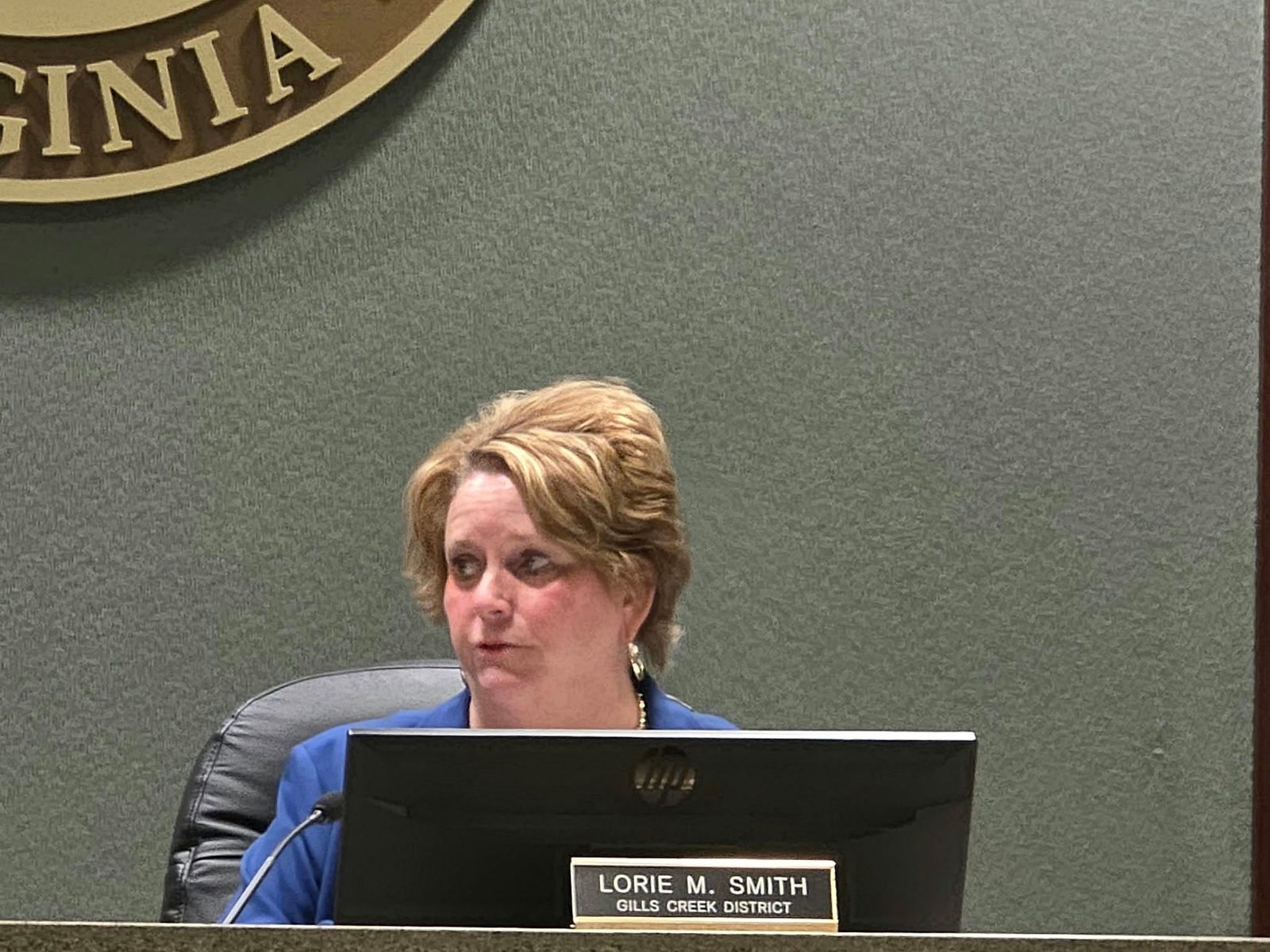
“Our job is the high bar way up here of making sure that we have best practices, accountability, and transparency in place,” she said during the meeting. “If it were on our side of the table, and our staff had made such egregious errors, you can rest assured I’d be saying the very same thing to our staff. It’s unacceptable.”
That standard now frames a different set of questions about the Board’s own procedures and its responses.
How will Smith respond to questions about the Board’s own accountability after publicly demanding transparency and higher standards from the school system?
For Quinn and Meredith, the issue is whether the Board holds its attorney to the same standards it has applied to its own members.
But Guynn’s public explanation also exposed a question that goes beyond confidentiality.
The public record does not establish an authorizing vote in open session.
And the county paid the bill before supervisors were asked to ratify the expenditure.
So, who, ultimately, was responsible for making sure the county’s attorney answered to the county?
Part III examines the oversight and decisions behind the amicus filing.
Sources and reference links
- Oct. 20, 2026 regular meeting (county attorney’s report, 5:45:49). Watch the recording
- Oct. 5, 2026: WDBJ7, “Franklin County begins search for next administrator.” Read the report
- Part I: Who Authorized the Amicus Brief? Read the first installment
- Additional primary sources reviewed: Franklin County Board of Supervisors, Rules of Procedure, adopted Feb. 17, 2026 (Sections 8, E and H); June 16, 2026 regular meeting agenda, Attachment 10; June 16 meeting minutes (Item 10 removed from consent agenda).
- Franklin County Board of Supervisors — Rules of Procedure, “Amended 07/21/2026” (county document supplied for review; Sections 8, E and H).
- March 17, 2026, Board meeting — closed-session motion transcription supplied for review; screenshots of county meeting recording show closed-session certification chapter near 5:36:42 (7:30:38 total recording). Certification language and vote not verified from screenshots.
- Franklin County — March 17, 2026 Board agenda (closed-session exemptions) Open
- Virginia Code § 2.2-3707 (2026 amendments) Open
- Virginia FOIA Advisory Council — 2026 Legislative Update Open
- Virginia FOIA Advisory Council — Public Meetings, July 2026 Open
- Franklin County — January 5, 2026 Board packet (Rules of Procedure) Open
- Franklin County — June 16, 2026 Board packet (proposed Rules amendment) Open
- Franklin County — Agenda Center (agendas and minutes) Open
- June 16, 2026 meeting recording / third-party meeting page Open