Foreword
For months, I have asked members of the Franklin County Board of Supervisors questions about their decisions, their conduct, and the rules governing their actions. Some have answered. Others have remained silent. And some have challenged the reporting itself.
Following the Board meeting concerning Mike Meredith’s disputed resignation, Vice Chairman Nick Mitchell declined to answer whether he wanted Meredith to return to office. He also challenged the accuracy of this reporter’s work.
On Oct. 12, Supervisors Mike Carter and Marshall Jamison separately declined interview requests. Carter questioned the accuracy of a published article. Jamison questioned this reporter’s credibility. Both exchanges are examined below.
Three supervisors. Three objections to the reporting. And many questions remain unanswered.
The exchanges are part of the story. But they are not the whole story.
Over the coming weeks, installments of “Who Answers to Whom?” will examine decisions, disputes and actions involving Franklin County’s elected leadership. The reporting will draw on public records, official correspondence, meeting minutes, interviews, and the Board’s own proceedings.
Where accounts conflict, readers will hear those differences. Where questions remain unanswered, they will be identified as such.
This series is not an invitation to accept my conclusions. It is an invitation to examine the evidence.
The documents will tell much of the story. Readers can decide what they mean.
Part One
Blue Ridge District Supervisor Tim Tatum arrived late for a special Franklin County Board of Supervisors meeting on Sept. 3.
He stepped into the Administrative Conference Room (ACR) and grabbed a slice of pizza. Four other supervisors were already gathered there. One of them, Marshall Jamison, had a copy of an article containing Tatum’s criticism of fellow supervisors.
“I sat down to eat and was immediately set in on by others for the statements that I gave you,” Tatum later wrote. “Marshall handed me a copy of your article and told me to read it.”
Jamison independently confirmed in an email that the encounter occurred and that five supervisors were present in the room when it happened:
“On 9/3 Mr. Tatum stated to three other supervisors and my self (sic) you had miss quoted (sic) him in that article,” Jamison wrote in an Oct. 12 email.
Tatum disputes that he said he was misquoted; he maintains the reporter quoted him accurately.
The four supervisors who confronted Tatum were Board Chair Lorie Smith and the three members Tatum has described as generally voting with her: Mike Carter, Nick Mitchell and Marshall Jamison. Carter and Jamison later declined interviews, questioning the reporting.
Five of the Board’s six sitting supervisors were thus together before the advertised meeting began. Their discussion raises a question under Virginia’s open-meetings law, though the available evidence does not establish a violation.
Tatum had not disclosed confidential information. He had criticized fellow supervisors, including Smith, and now found himself defending those remarks before four of his colleagues.
Their accounts raise questions about how elected officials respond to criticism and whether the gathering crossed the line between a private conversation and public business.
A quotation becomes a controversy
The dispute that led to the ACR encounter began with something Tatum put in writing.
On July 19, 2026, Tatum emailed this reporter concerning Smith’s influence on the Board.
“She has three members eating out her hand. I’m not one of them,” Tatum wrote.
The following day, Tatum identified those supervisors.
“I wanted to be chairman this year since I currently have been serving the longest,” Tatum wrote. “Mike, Nick, and Marshall would not vote for me. They go along with anything Lori wants for the most part. Marshall goes against her once in a while but not Mike and Nick.”
Tatum’s account identified Carter, Mitchell and Jamison as the three supervisors he believed generally supported Smith.
Tatum’s comments appeared in an Aug. 29 article examining events surrounding Meredith’s resignation.
The published quotation matched Tatum’s July 19 email word for word.
In a Facebook Messenger exchange following publication, Carter directly challenged the quotation, repeating the phrase Tatum had used.
“I asked Tatum if he said, ‘Lorie has three of them eating out of her hand’ he indicated he was incorrectly quoted,” Carter wrote.
He then put the question to the reporter: “Do you stand by your writing? or was Tatum not quoted correctly?”
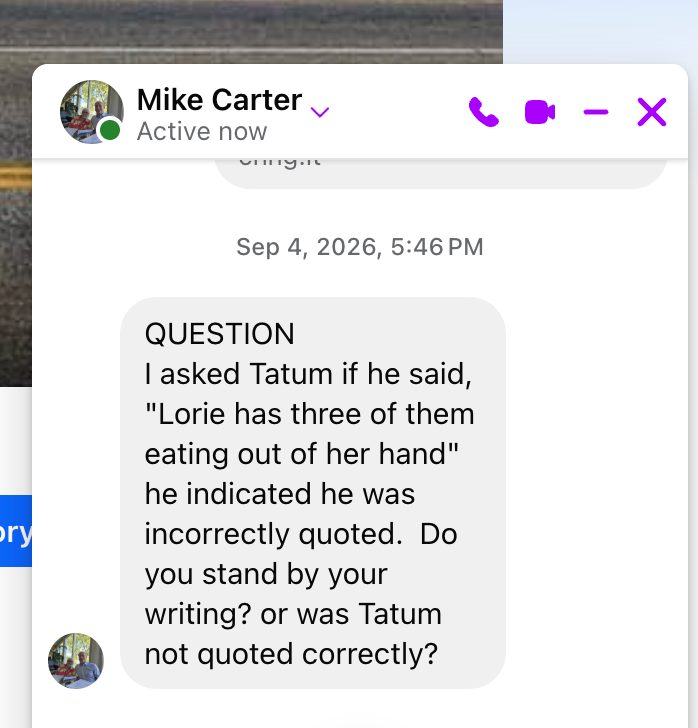
The exchange, which occurred on Sept. 4, 2026, marked an early, explicit challenge to the accuracy of the published remark.
Mitchell had also challenged this reporter’s work. Following a Board meeting concerning Mike Meredith’s disputed resignation, the vice chairman was asked whether he wanted Meredith to return to office.
“I’m not gonna answer any of your questions, Dave,” Mitchell said.
Asked why, Mitchell replied:
“I’m just not. You’ve taken enough stories and twisted them.”
The exchange was recorded on video. Mitchell’s criticism concerned the reporter’s coverage more broadly; Carter’s subsequent objection focused on the accuracy of a particular quotation.
Carter and Jamison had not responded to earlier emailed requests for comment from this reporter. Their October replies therefore marked a change: Rather than address the underlying reporting questions, both cited concerns about the reporter’s accuracy or credibility.
Carter’s email arrived at 3:30 p.m. on Oct. 12, 2026; Jamison’s followed at 4:09 p.m. on the same day—just 39 minutes later.
The timing alone does not establish coordination. The two emails addressed the reporter’s work in related, though differently worded, terms.
Carter’s email read in part:
“This decision comes after a recent article of yours in which Tim Tatum, the supervisor for the Blue Ridge District, stated that he was misquoted,” Carter wrote. “Because of the concerns surrounding the accuracy of that piece, I feel it is best to pass on an interview to ensure there is no further miscommunication.”
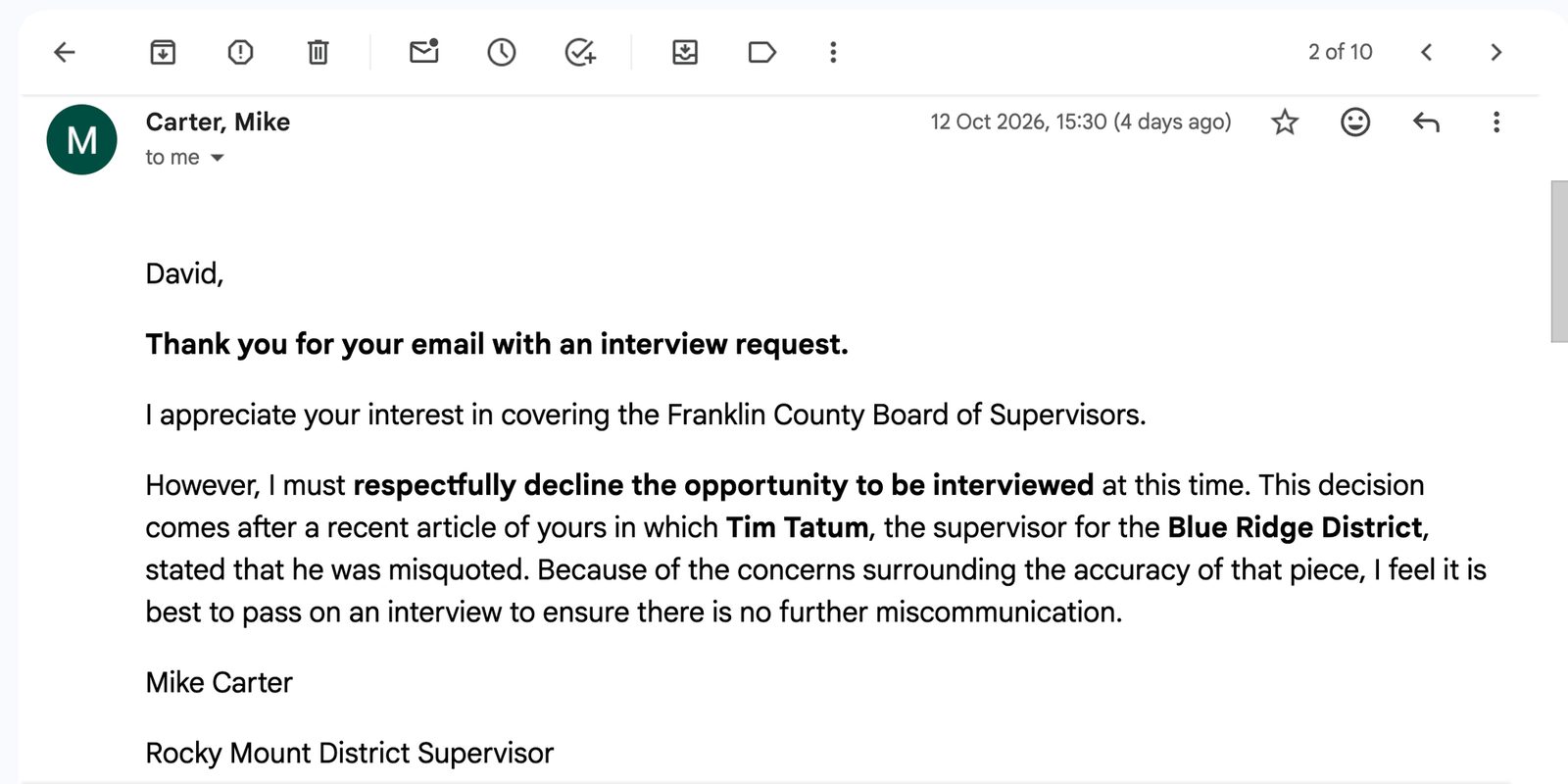
Jamison’s email went further:
“I have no comment on this or any other questions you have in the future. I have serious concerns with your credibility as a journalist. I questioned Supervisor Tatum on his comments to your 8/28 article “What Really Happened Behind Closed Doors “. (sic) On 9/3 Mr Tatum (sic) stated to three other supervisors and my self (sic) you had miss quoted him in that article. He said on 9/9 He (sic) met with you and discussed the article but you would not consider a redaction and he walked out. Again, to avoid any possible conflict or confusion, I have no comments on your email. Marshall Jamison”
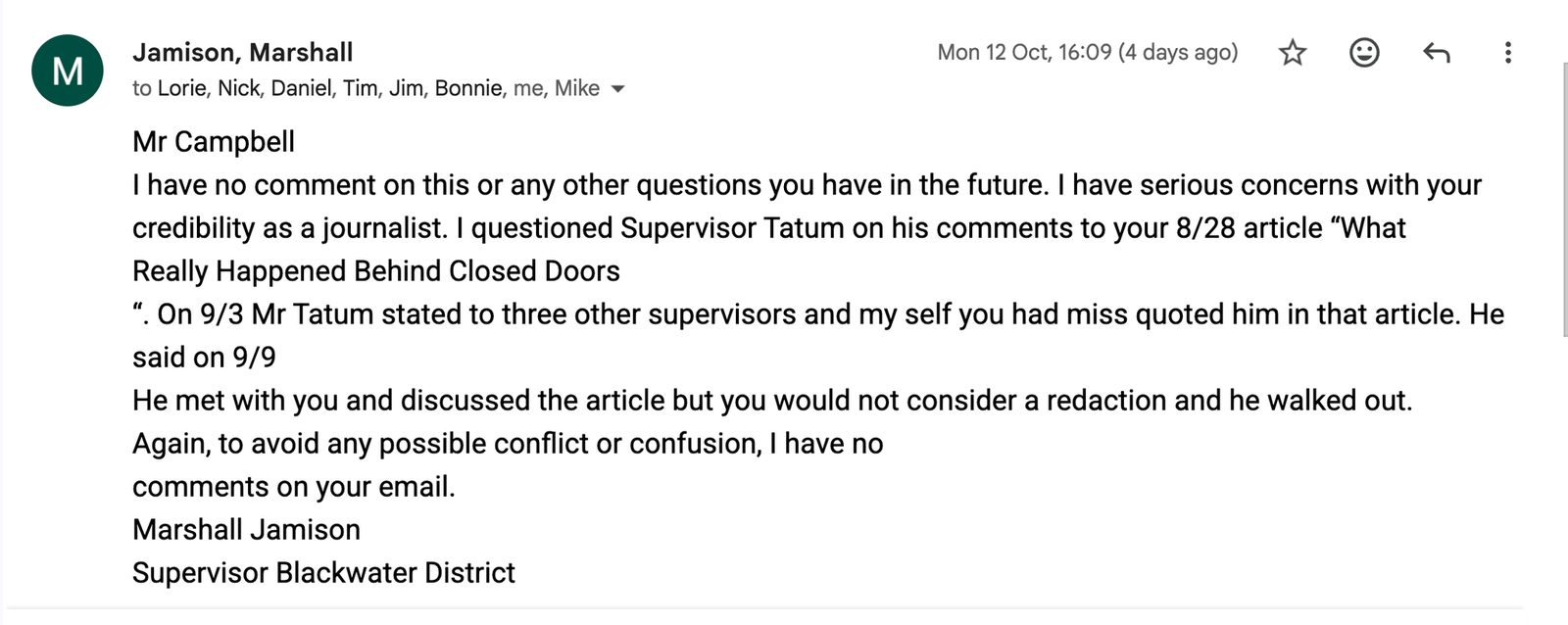
Jamison also claimed that a later meeting between Tatum and the reporter ended after the reporter refused to consider a redaction.
Tatum tells a different story.
“What I told you was certainly my opinion,” Tatum wrote Oct. 12. “I misspoke by making that comment without having solid proof of it.”
He did not withdraw the underlying opinion.
“I’m not saying that it was false,” he wrote.
Tatum elaborated on whether he had been misquoted.
“You quoted what was said but I should not have been giving my opinion as fact without proof.”
He added:
“I don’t think I said that you misquoted me but that I didn’t make myself clear.”
Tatum also disputed Jamison’s characterization of the meeting with the reporter.
“I did tell them that I met with you but I didn’t mention changing the quote,” he wrote.
Tatum said the conversation was brief and that he left because he needed to return to work.
The competing accounts raise questions about how a disagreement over Tatum’s comments became an allegation that a reporter had misquoted him.
Tatum later confirmed that the meeting ended aamicably. He and the reporter walked out together, spoke briefly on the sidewalk and said goodbye.
But Tatum’s subsequent description of Sept. 3 raises another question—one extending beyond the accuracy of a published quotation.
Inside the conference room
Tatum described what happened after he joined the four supervisors in the ACR.
“This was on Sept. 3rd in the ARC (sic),” Tatum wrote. “I arrived late and grabbed a slice of pizza that was provided for us. I went in to eat and there were 4 others in there.”
Tatum said he had already read the article.
“I got defensive because I felt like I was under attack,” Tatum wrote. “I informed them that the statement didn’t come out the way I intended.”
For Tatum, the encounter also raised concerns about the consequences of speaking openly.
“I have always tried to be as open to questions as I could,” he wrote. “I felt that was my duty. The others will be out for me for sure.”
The statement reflects Tatum's concern about how his colleagues might respond to his willingness to speak publicly, particularly when his comments were critical of the Board, its actions, or individual supervisors. It does not establish that any retaliatory action was taken.
Then, Tatum said, someone characterized him as having been misquoted, but he wasn’t the person who introduced that assertion.
“One of the others, I’m not sure who either Nick or Mike, said that I was misquoted then,” Tatum wrote. “I didn’t correct him but let it go.”
Tatum said he regretted failing to correct the statement.
“I am sorry,” he wrote. “I will clear this up at our next meeting under other matters by supervisors.”
Tatum also clarified who was present.
“The only person not there was Dan (Quinn),” he wrote.
At the time, Meredith had already resigned and the Boone District seat remained vacant. Union Hall District Supervisor Quinn participated remotely in the subsequent special meeting.
Tatum initially described the encounter as an effort to intimidate him.
“It was clear that I was being set up for a censure when I was corned by four people at one time,” he wrote.
He subsequently clarified that none of the four supervisors mentioned censuring him during the encounter.
“They never mentioned censure,” Tatum wrote. “Dan told me that I was probably going to be censured. No one else mentioned it.”
Quinn, Tatum clarified, made that comment later and was not present in the ACR.
What happened in the room?
Tatum could not say what the four supervisors discussed before he arrived.
He initially suggested they appeared to have been discussing the article, but qualified that impression.
“I can only assume what was said before I got there. But it would be an assumption.”
After he entered, however, Tatum said the four were together, and he described the exchange as a group conversation.
“They were all talking,” he said. “They were all on board with each other.”
He recalled that the remarks were not directed only at him.
“They were speaking to each other as well as to me to best I can recall. Sorry I can’t be more exact,” he wrote.
Why, Tatum’s criticism become the subject of a confrontation involving four other supervisors before a public meeting?
A meeting before the meeting?
Virginia Code § 2.2-3701 defines a meeting to include an “informal assemblage” of “as many as three members” of a public body, “wherever held, with or without minutes being taken, whether or not votes are cast.”
The same statute excludes certain gatherings where none of the purpose is discussing or transacting public business, the gathering was not arranged for that purpose, and no public business is discussed among members. For this definition, “public business” means “any activity a public body has undertaken or proposes to undertake on behalf of the people it represents.”
A 2025 Virginia Freedom of Information Advisory Council opinion emphasizes two elements: at least three members gathered and discussion or transaction of the public body’s business among those members. Their mere presence together is insufficient.
According to Tatum, five of Franklin County’s six sitting supervisors were together in the ACR before the Sept. 3 meeting. Tatum’s account corroborates Jamison’s email that there were five supervisors present.
The number present raises the possibility of an informal meeting; whether their conversation involved public business is the unresolved legal question.
The available evidence does not establish a violation.
It provides a first-hand account of five supervisors discussing a matter involving Board members before their scheduled public meeting.
Smith, Mitchell, Carter and Jamison were contacted collectively and asked to respond to Tatum’s account, explain the purpose of the gathering and address whether Board business was discussed.
They were also asked about the allegations that Tatum had been misquoted and the standards governing disclosures from closed sessions.
Tatum and Quinn responded to inquiries about the episode. Smith, Mitchell, Carter and Jamison did not provide accounts in the responses reviewed for this story. County Attorney Jim Guynn did not respond to emailed questions.
The unanswered question
The written record establishes what Tatum originally told the reporter.
Tatum acknowledges that the published words were accurate. Jamison maintains that Tatum told colleagues he had been misquoted; Tatum says someone else made that claim and he failed to correct it.
What remains less clear is why four supervisors confronted him over those remarks before a public meeting, especially considering Tatum didn’t disclose any confidential information?
The larger question, however, is whether their discussion crossed the boundary between private disagreement and public business.
The questions remain.
Check the record
- Sept. 3, 2026 special called meeting. Watch the recording · Minutes · Agenda
- Aug. 29, 2026: “What Really Happened Behind Closed Doors.” Read the article that quoted Tatum
- Sept. 4, 2026: “The supervisors had their closed session. The public had theirs.” Read the article with the Mitchell exchange
- Virginia Code § 2.2-3701. Definition of “meeting” under the Freedom of Information Act